THE TECHSPRESSIONIST JOURNALISSUE 002
Digital Expressionism
The Fourth Wave
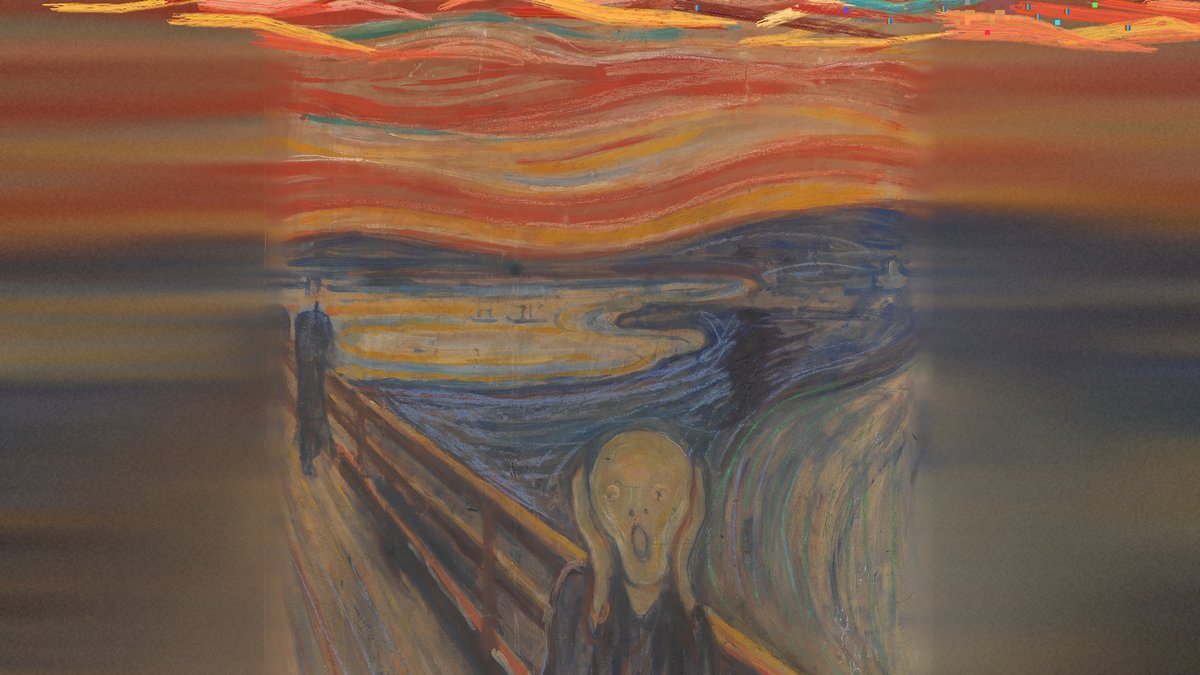
Four waves, one scream · Colin Goldberg, 2026. Opening still for the video cover, after Edvard Munch, The Scream (1893), public domain; code-made alterations. Full sources and alterations.
Links marked ▶ open the archive recording at the exact moment quoted.
What is digital expressionism?
On November 17, Christie’s in New York put a Kandinsky on the block with an estimate of up to $80 million and a guarantee that it would set his auction record (USA Art News). The picture, Betonte Ecken, is about a hundred years old. The argument behind it is newer than it looks: that a color can carry a feeling the way a chord does.
Digital expressionism is that argument, made with a screen. It is art that uses digital tools (software, code, printers, augmented reality, now AI) to show what an artist feels rather than what they see. The brush changed. The reason for picking it up did not. Which is why the artist and curator Patrick Lichty has called it, “kind of,” expressionism’s fourth wave: first Munch, the German Expressionists and Kandinsky; then American Abstract Expressionism; then Neo-Expressionism; and now art made with technology.
Since 2011 the most specific name for it has been Techspressionism: “an artistic approach in which technology is utilized as a means to express emotional experience.” Today the Techspressionism artist group counts more than 350 artists in over 45 countries. They argue about all of this in recorded online Salons, and their searchable video archive is where every quote below comes from.
The first wave: a scream, a bridge and a blue rider
Start with the scream. Edvard Munch painted The Scream in 1893, and it became the most recognizable picture of an inner state ever made. Munch didn’t set out to found a movement, and he didn’t name one. The word came from the exhibition business. In April 1911 the Berlin Secession, led by Lovis Corinth, called a group of French painters “Expressionisten,” and the critic Max Osborn wrote that they “had broken with Impressionism” (Leicester German Expressionism project). A year later the Sonderbund show in Cologne used “Expressionismus” for art from across Europe and gave Munch a retrospective, recasting the label as a northern tradition with Munch at its root (source, after Shulamith Behr, Expressionism, Tate 1999). The name stuck because it described a feeling, not a technique. Munch knew the feeling from the inside. “For several years I was almost mad,” he wrote, tying that time to The Scream. In 1908 he checked into Daniel Jacobson’s clinic in Copenhagen for eight months of treatment (Wikipedia). His creed became the first wave’s: “I do not believe in the art which is not the compulsive result of Man’s urge to open his heart.”
In Dresden in 1905, four architecture students led by Ernst Ludwig Kirchner formed Die Brücke, “The Bridge,” to cross from the old art to a new one. Their crossings were jagged woodcuts and acid-bright city streets. In Munich in 1911, Wassily Kandinsky and Franz Marc launched Der Blaue Reiter, “The Blue Rider,” with Gabriele Münter and August Macke. Marc painted blue horses because blue felt right, not because horses are blue. Kandinsky went further and let the horse go entirely. By Composition VII in 1913, nothing recognizable was left, only feeling.
Both groups used the newest tools they had: cheap printmaking, new pigments, and, in 1912, a printed almanac that carried their ideas across Europe. A bridge and a rider are, after all, two ways to get somewhere.
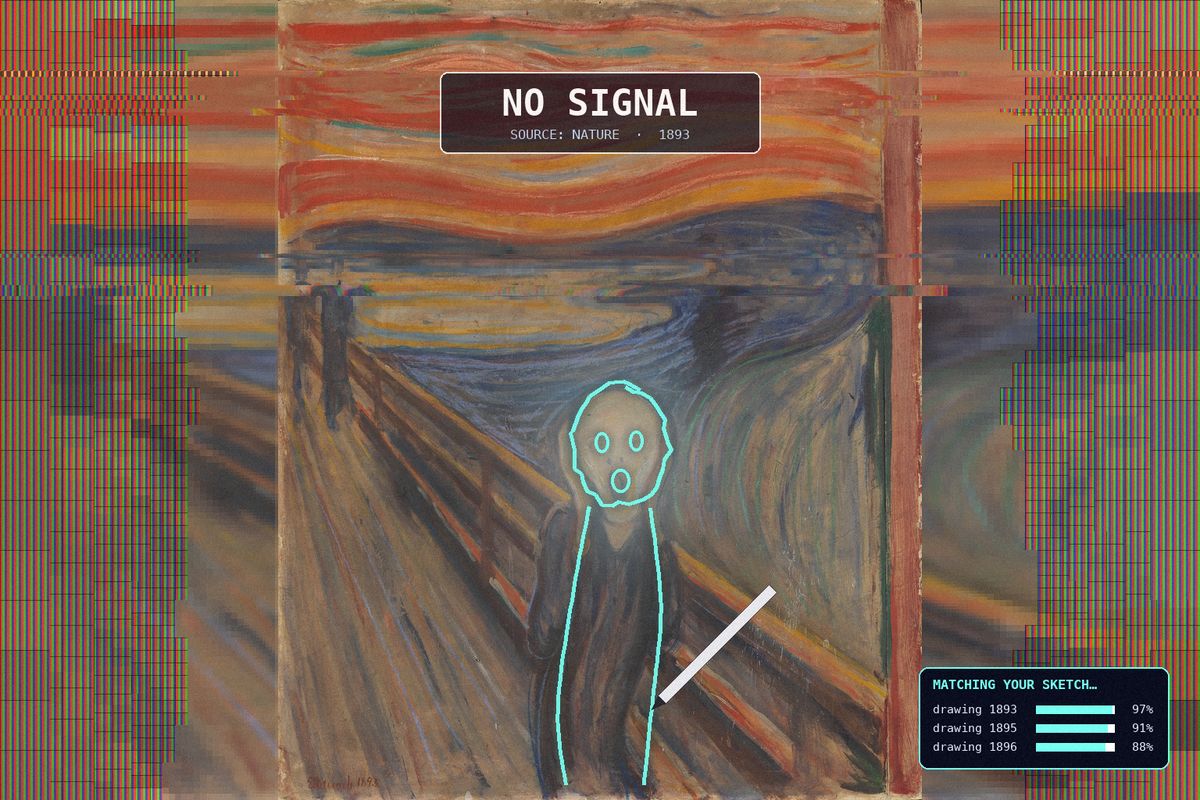
That first wave never quite left. This month the Munch Museum in Oslo invites visitors to draw on a tablet and lets AI match each sketch to one of Munch’s roughly 7,000 drawings, through November 29 (Munch Museum). Munch, who painted the emblem of inner feeling, is now answering visitors through a screen.
Waves two and three
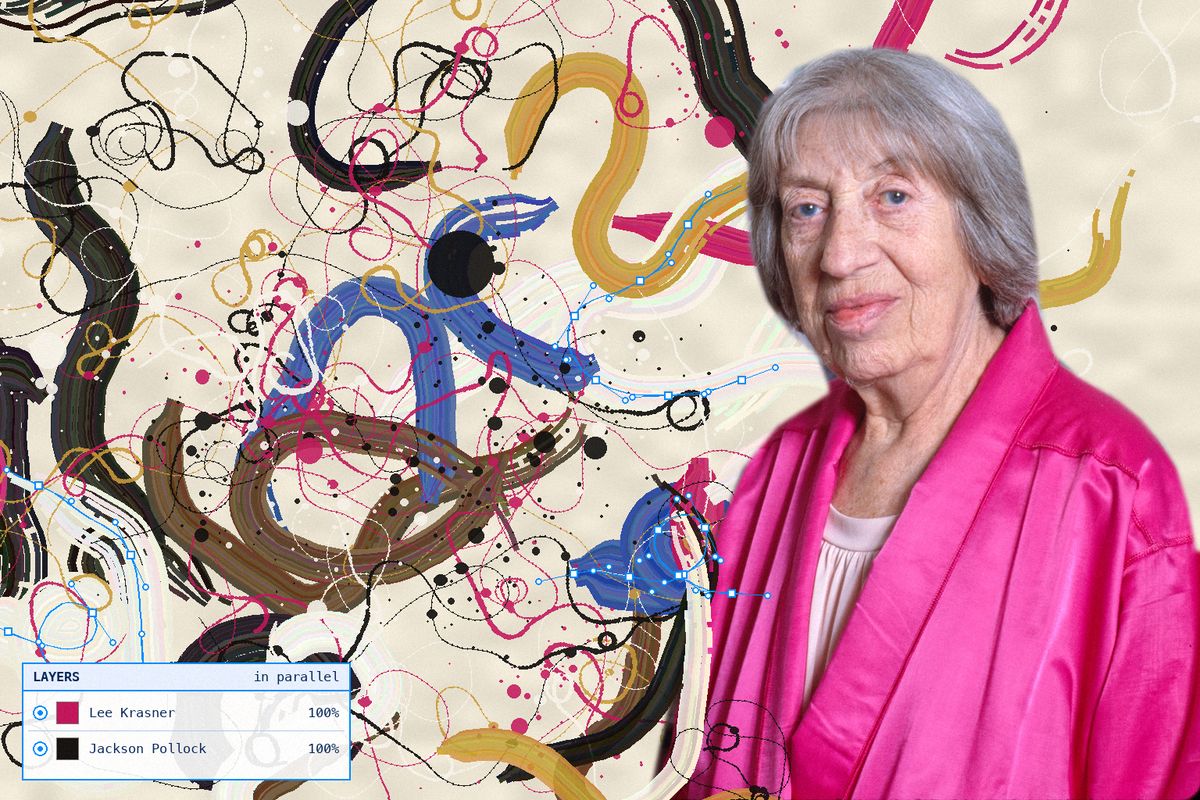
The second wave crossed the Atlantic, and a critic carried the name across. Alfred H. Barr Jr., founding director of the Museum of Modern Art, had used “abstract expressionism” for Kandinsky in 1929. In 1946 the New Yorker critic Robert Coates applied the same words to a young New York painter, Hans Hofmann (Wikipedia). The term jumped the ocean before the painters were famous. Lee Krasner, Jackson Pollock, Willem de Kooning, Mark Rothko and Franz Kline made it the loudest art of the 1950s. Clement Greenberg argued for them, and Harold Rosenberg gave them a slogan in 1952: the canvas had become “an arena in which to act.” Paul D. Miller, the artist and composer better known as DJ Spooky, points out that the timing was political: in the Cold War, American abstraction became “a countervailing ideology” to Soviet realism, and “the CIA helped sponsor a lot of early abstract expressionist exhibitions.” (watch at 20:15) The figure this wave keeps rediscovering is Lee Krasner. This fall the Metropolitan Museum of Art puts her name first: Krasner and Pollock: Past Continuous “charts the full arc of the careers of Lee Krasner (1908–1984) and Jackson Pollock (1912–1956) in parallel,” with more than 120 works from over 80 lenders, through January 31, 2027 (The Met). Parallel is the key word, and the fourth wave wrote equal billing into its own principles. An artist put it there. In 2021 Renata Janiszewska told a Salon that “the values of feminism, you know, gender politics, sexual politics, mental health” run through the way the group includes people, and she offered to write inclusivity into the manifesto herself. (watch at 1:37:04) Her addition became its final tenet, on gender equality.
Harrison ran Krasner and Pollock’s house and studio in East Hampton for decades, and she tells a story the wall labels can’t. When Pollock showed his stark black paintings at Betty Parsons in 1951, someone asked Krasner whether he “couldn’t do it in color.” Harrison sums up Krasner’s answer: “You don’t do it because it sells, you do it because you need to do it.” (watch at 45:48) Co-founder Steve Miller saw the second wave hit as a kid. When Buffalo’s Albright-Knox bought Pollock’s Convergence and hung it in a stairwell, he says, “the idea of that much paint flying through space just, like, knocked me out.” Then came the turn: he decided the next breakthrough in visual language “was technology, working with computers,” and before the personal computer arrived he was working on TV graphics computers. (watch at 14:32)
The third wave arrived in the 1980s, and the critics named the family resemblance right away. Germany called its painters the Neue Wilden, “the new wild ones.” Critics Donald Kuspit and Achille Bonito Oliva saw the movement as a revival of the old expressionist themes of self-expression, and Robert Hughes called it “retrograde” (Wikipedia). Neo-Expressionism gave us Anselm Kiefer‘s scorched fields, Julian Schnabel‘s broken plates, Jean-Michel Basquiat‘s crowns. Downtown, his friend Keith Haring was drawing in white chalk on the black, empty ad panels of the New York subway, starting in December 1980. When Haring opened his Pop Shop in 1986, critics accused him of commodifying his art. He answered that the shop was “an extension of what I was doing in the subway stations, breaking down the barriers between high and low art” (Wikipedia). The market still remembers it. Two days after the Kandinsky, Christie’s leads its 21st Century Evening Sale with Basquiat’s Untitled (Leonardo and His Five Grotesque Heads), estimated at around $30 million (USA Art News).
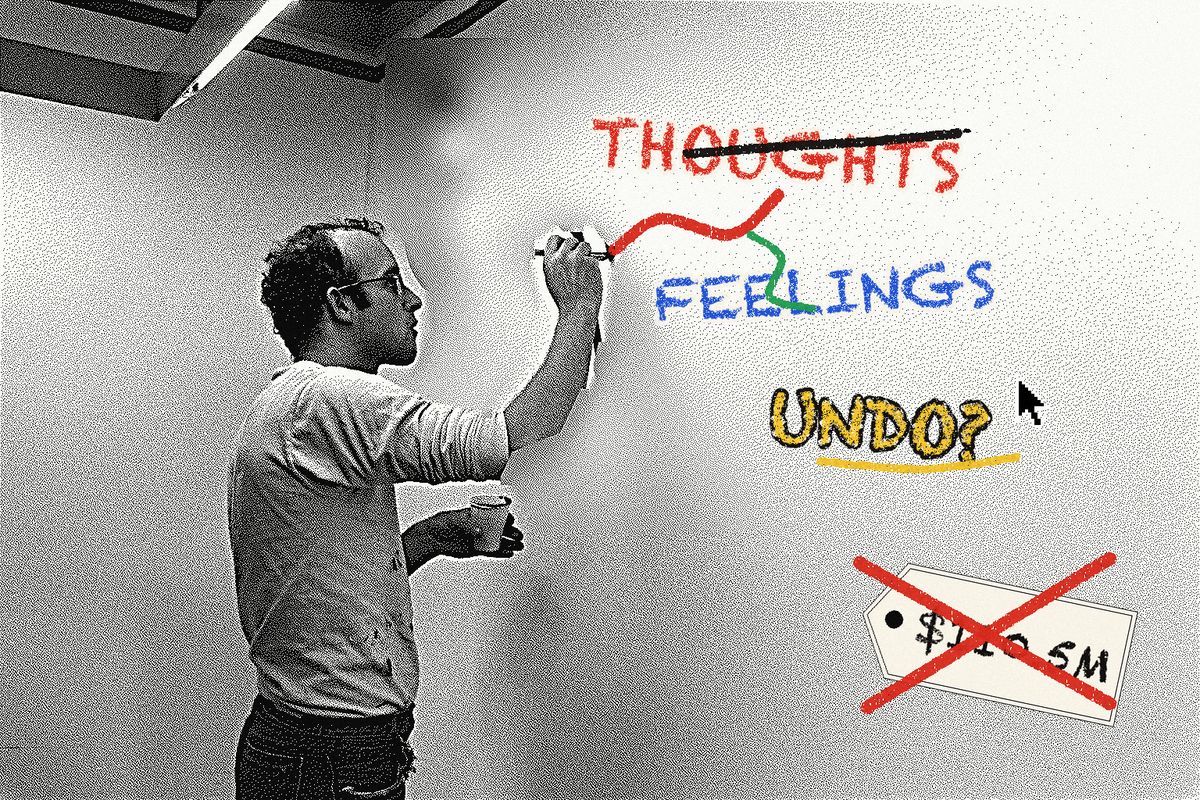
The numbers hide a darker story. Basquiat was a young Black artist in an overwhelmingly white market. His first dealer, Annina Nosei, gave him materials and a place to work in the basement of her gallery. In 1982 he canceled a show in Modena, saying he “felt exploited because he was expected to make eight paintings in one week.” Hilton Kramer dismissed him as a “talentless hustler” who traded on his “skin colour.” He died in 1988 at 27. In 2017 one of his paintings sold for $110.5 million (Wikipedia). The art world wanted the paintings. It was less sure what to do with the painter.
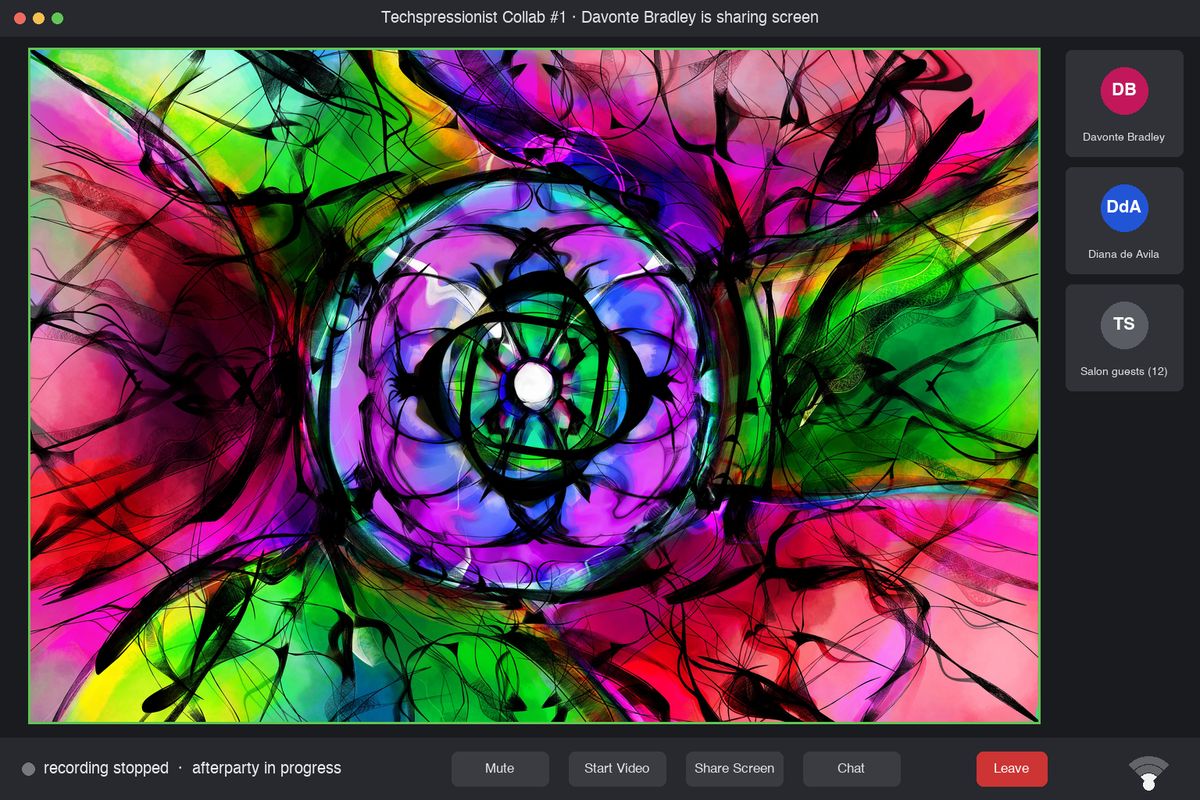
Davonte “Davo” Bradley, an artist and one of the group’s seminal members, says he “started studying Basquiat a lot” because he “felt very strongly about his story and his life.” Of “some of the symbols like the crown,” he says, “I put that in a couple of paintings… this is me respecting you.” The rest, he says, is “self graffiti”: “thoughts and feelings and stuff that I couldn’t actually like just push away.” (watch at 26:31) Bradley came up with the Techspressionism Collab shows, among the group’s first exhibitions. The first, Collab #1 in 2020, paired artists to make work together, among them Bradley himself with Diana de Avila. They took their cue from Basquiat’s shared canvases with Andy Warhol and moved the idea online.
The fourth wave
The name comes from Patrick Lichty, an artist, curator and Techspressionism co-founder. In August 2022 he told a Salon that the movement is “revisiting expressionism through technology,” and that “this is the fourth wave, kind of.” (watch at 29:58) Note the “kind of.” Lichty offers it as a description, a family resemblance, the way “Neo-Expressionism” was a handy label for Kiefer and his generation. He isn’t claiming that Techspressionism descends from the earlier ones, and in the same breath he called the group’s common ideology “pretty loose.”
So what do the four waves share? Not a family tree. They share a definition. A dictionary puts it plainly: expressionism “tries to express people’s feelings and emotions rather than showing events or objects in a realistic way” (Oxford Learner’s Dictionaries). The word itself comes from the Latin exprimere, literally “to press out” (Etymonline). Every wave presses something out, from the inside, with whatever tools it has.
Techspressionism’s own definition comes straight out of that dictionary entry, and its history is short enough to tell in four steps (history):
- 2011. “Techspressionism” first appeared as the title of a solo show at 4 North Main Gallery in Southampton, New York, with a catalog foreword by Helen A. Harrison.
- 2014. The Techspressionist Manifesto defined the word as an amalgam of the Oxford definitions of “Expressionism” and “technology”: an artistic style in which technology is used to express emotional experience “rather than impressions of the external world.”
- September 1, 2020. At the first virtual Salon, Harrison suggested changing “style” to “approach,” and co-founder Oz Van Rosen suggested dropping the clause about the external world.
- Today. The definition reads: “An artistic approach in which technology is utilized as a means to express emotional experience.”
So the core of the word was never invented. It was borrowed from the dictionary’s definition of expressionism and kept, nearly whole, for more than a decade.
Not everyone in the group agrees, and that’s half the fun. The arguments between artists are what keep a movement lively. Every Salon ends when the recording stops and the Afterparty begins. It’s an open, unrecorded conversation where members keep talking, pitch ideas and choose the next Salon’s topic, and it took the place of a formal advisory board. It’s people expressing themselves, which is the point. The Salons are on the record at all because of Bradley. He moderated many of the early ones and suggested recording them and starting a YouTube channel, and every watch link in this issue goes back to that idea. Loose isn’t the same as light. A group that holds that the feeling matters more than the tool, and that has written inclusion, gender equality and mental health into its principles, has taken a position. Every wave before it did the same. Die Brücke set out to cross away from the academy, and Der Blaue Reiter wanted the spiritual back in painting. None of them had a party line either. Their members argued too.
Lichty’s description stuck, and the group now uses it to lay out the four in sequence.
Is that just us talking? Not entirely. In 2005 Kuspit, the critic who had read Neo-Expressionism as expressionism reborn, looked at the computer and saw the next chapter. Avant-garde painting since Manet, he wrote, “was a time of transition from traditional analogue art to postmodern digital art.” The computer “offers new hope for art at a time when the traditional media seem to have exhausted their potential,” and even “signals a new Renaissance of art-making.” He traced the line back to Kandinsky, and he called Georges Seurat, with his dots, “the first digital artist.” (artnet, “The Matrix of Sensations”) To be fair, Kuspit thought code would replace self-expression rather than serve it. The fourth wave makes the opposite bet.
The history that gets told, and the one that doesn’t
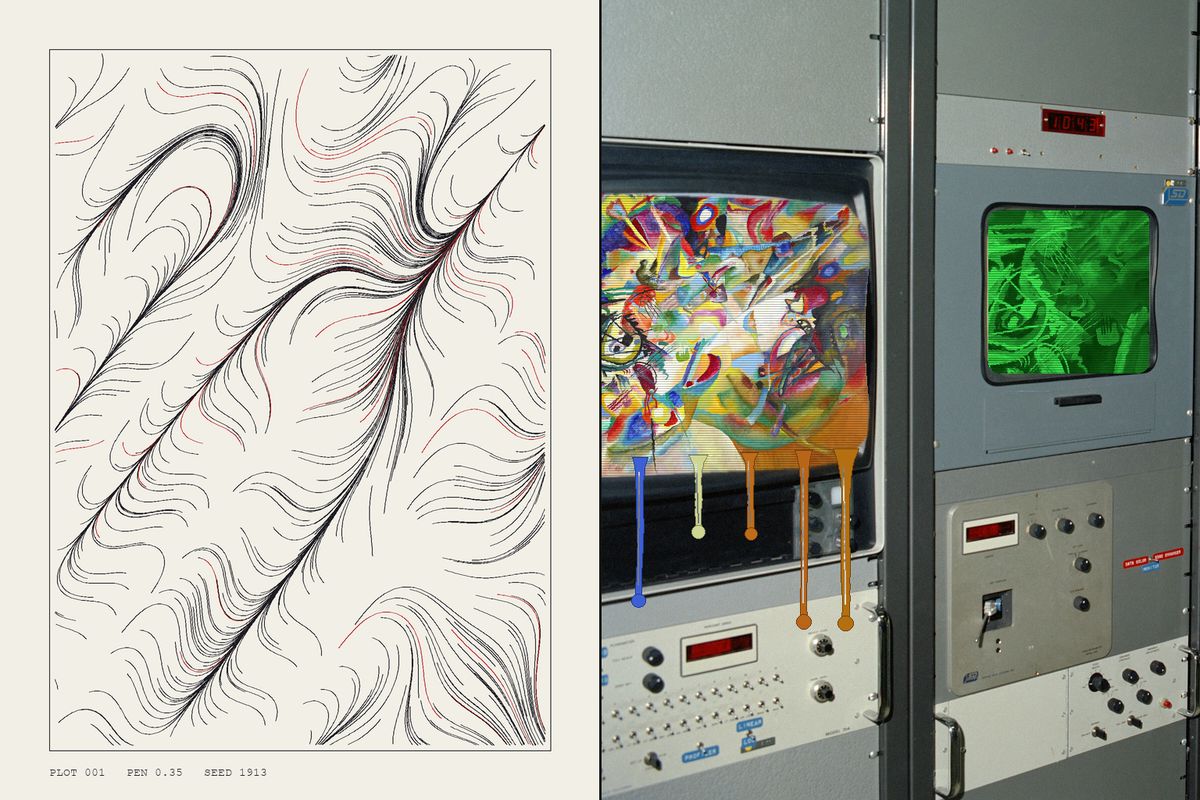
Ask a museum where computer art began and you’ll usually hear about code. Computer Worlds, on view at the West Bund Museum in Shanghai until February 14, 2027, traces the story through the Centre Pompidou’s collection from the 1950s on, with pioneers of algorithmic art such as Vera Molnar, Herbert Franke and Manfred Mohr (Centre Pompidou). It’s a real history. In that story the artist writes the rules and the machine draws.
There’s a second history running alongside it. In it the artist draws, and the machine is the canvas. David Hockney made it famous: his iPad paintings filled Serpentine North in London from March to August this year (Artlyst). Co-founder Oz Van Rosen walked past an Apple Store iPad Pro demonstration in 2017 and thought, “there’s, like, an entire studio in that thing!” The next thought was a name: “there was abstract expressionism. Well, what if I called it abstract Techspressionism?” (watch at 9:41) Plenty of painters got there decades before the tablet. The skeptics showed up early too. The painter Darcy Gerbarg, who came up among the color-field painters around Greenberg, once took him, the most powerful critic of Abstract Expressionism, through a computer-art exhibition curated by Cynthia Goodman. Everyone was asking whether art made with computers was art at all. His verdict: “it might be art but it’s bad art.” (watch at 45:42) The good news is that “bad art” still counts as art. It’s how every wave begins.
So the question to ask of digital expressionism is the one Pollock asked of paint. Not “what made it?” but “what is it saying?” A digital work isn’t a filter any more than a Pollock is a spill.
And AI?
The fourth wave now has a brush that seems to paint by itself, and the generative history is suddenly everyone’s favorite family tree. But WIRED had already reported the group’s answer to the authorship question in 2014: “Nothing is ever truly computer-generated,” and “The human mind has always provided the code.” (WIRED) Kandinsky had a word for what drives that code: inner necessity. The machine makes the marks. The person decides why.
Insiders to the outside, outsiders from within
Look at the line again. Munch painted his way through anxiety and breakdown. Die Brücke turned its back on the academy. Krasner had to wait for a major museum to hang her career beside her husband’s as an equal. Basquiat was a young Black painter whom the market prized for his prices while a leading critic sneered at his skin. Haring, openly gay, started in the subway, was called “overpromoted” and “faddish” by Time, and turned his imagery to AIDS awareness before he died of the disease in 1990, at 31. Expressionists have always been outsiders, and that is where the work comes from. And outsiders find each other. Die Brücke and Der Blaue Reiter were groups of friends before they were styles. In the 1950s Pollock, de Kooning, Rothko and Kline drank and argued at the Cedar Tavern in Greenwich Village, near Robert Motherwell’s weekly artists’ salon (Wikipedia). Around 1980, Haring curated a gallery on the fourth floor of the Mudd Club in TriBeCa, where Basquiat’s band Gray played (Wikipedia). The fourth wave meets on a video call: first the Salon, then the Afterparty. Each wave bonded the same way. Outsiders build their own rooms. When enough doors close in your face, you build your own house. Then, sooner or later, the outcasts become celebrities. The Scream becomes the most recognizable picture of feeling ever made, Krasner and Pollock fill the Met, and a Kandinsky and a Basquiat headline the same week at Christie’s. The establishment that kept them out ends up selling the tickets.
Today’s outsiders work on screens. Greenberg’s verdict on computer art, “it might be art but it’s bad art,” followed artists like Gerbarg for decades. Digital painters still hear that it’s just a filter. Bradley, who is light-skinned and Black, grew up being told he was “too white to be Black, but also too Black to be white.” When people in the art world wave off digital work (“ah that’s not real art”), he says, “that feeling very much reminds me about my particular position in the world in my community.” (watch at 34:08) It’s just like the other waves: new tools, a feeling pushed out through them, and an establishment that isn’t sure it counts. (The celebrity part can wait.) The fourth wave answers by writing the outsiders in: open to all artists, whatever their age, race, background, gender or sexuality, and mindful of mental health. Munch, Krasner and Basquiat would each have found a place in it.
Harrison wrote the first text on Techspressionism, the 2011 catalog foreword for that first show (history). Looking back in 2025, she said many artists “were already doing this stuff… They just didn’t know that there was a tribe out there that they could sign up for.” (watch at 1:12:20)
Die Brücke had a bridge. Der Blaue Reiter had a rider. The fourth wave has a Wi-Fi signal, and the door is open. Browse the artists, watch a Salon or join the group.
Further listening in the archive
- Founders: Five Years Later (2025): Colin Goldberg, Helen A. Harrison, Patrick Lichty, Steve Miller and Oz Van Rosen
- Salon 49: Movement (2022): Patrick Lichty on the fourth wave
- Davonte Bradley interview (2021)
- Salon 104: History, Theory, Connectivity (2026): the fourth-wave panel
Credits
Text and images by Colin Goldberg, contributing author and artist. AI tools were used in the research and writing: Claude for research, drafting, editing and fact-checking, and for writing the Python code used to recompose the illustrations; Runway to animate the cover. No generative image model was used for the illustrations. Colin Goldberg directed the editorial and visual development.
The illustrations combine and transform the source images credited below. They are artistic interpretations, not photographs of the works or events discussed. Original artists, photographers, institutions and applicable licenses appear in Image credits and alterations.
Cite this TSJ issue
Goldberg, Colin. “Digital Expressionism: The Fourth Wave.” The Techspressionist Journal (TSJ), issue 002, November 23, 2026. https://techspressionism.com/journal/digital-expressionism/. Accessed [date].
For definitions and context: What is Techspressionism? · Techspressionist Manifesto.
Image credits and alterations
Cover still: after Edvard Munch, The Scream (1893), Nasjonalmuseet, Oslo; public domain. Code-made alterations. This still stands in for the animated cover, which is in production.
No signal, 1893: after Edvard Munch, The Scream (1893), Nasjonalmuseet, Oslo; public domain. Code was used to add a “no signal” screen, a stylus sketch, a sketch-matching panel and RGB pixel breakup. The panel’s figures are illustrative.
In parallel: Bernard Gotfryd, Lee Krasner, artist (1983), Library of Congress, Prints and Photographs Division, LC-DIG-gtfy-01933; no known copyright restrictions. The painting behind the sitter, a copyrighted Krasner work, was removed and replaced with a code-made gesture field and a software layers panel.
Self graffiti: Rob Bogaerts / Anefo, Keith Haring at work (March 14, 1986), Nationaal Archief, The Hague; CC0 1.0. Haring’s mural was removed. The photo was dithered, and code-made scrawls, strike-throughs, a crossed-out price tag and a cursor were added. No Haring or Basquiat artwork is reproduced.
Afterparty in progress: Davonte Bradley and Diana de Avila, BRADLEY x de AVILA (Freed) (2020), digital artwork from Techspressionist Collab #1, shown unaltered and courtesy of the artists, inside a code-drawn video-call window.
Two histories: after Wassily Kandinsky, Composition VII (1913), State Tretyakov Gallery, Moscow; public domain. Martin Brown, computer console at NASA Lewis Research Center (1975), NARA 17444711; US public domain as a NASA work. The left half is a plotter-style drawing generated by code. On the right, a NASA employee was cropped out, and paint drips and a phosphor screen were added.
Subscribe to the Journal
One issue. One article. Get new issues by email.