Salon 95 // Live from Chelsea
Video Description
Hello, Chelsea! // Techspressionism 2025 presents over 100 expressive, innovative works from artists spanning over 20 countries. The exhibit will be open to the public at Hudson Guild Gallery from April 30th to June 25th, 2025.
ARTIST PANEL: Building Community
Roz Dimon - https://www.rozdimon.com/ Carla Gannis - https://carlagannis.com/ Colin Goldberg - https://goldberg.art/ Seungjin Lee - https://www.instagram.com/seungjin888/ cari ann shim sham - https://www.cariannshimsham.com/ Ann Shapiro - https://www.annrshapiro.com/ Nina Sobell - https://ninasobell.com/
Exhibition Information: techspressionism.com/chelsea/
Synopsis
Click a time code to jump to that point in the video, or an artist’s name to learn more about them.
Salon 95, "Live from Chelsea" (June 5, 2025), is a hybrid salon from the Hudson Guild Gallery in the Hello Chelsea exhibition, hosted by Tommy Mintz. The discussion is about community. Roz Dimon describes a group she started called Picture Element▶ 3:40 and spending half her time online▶ 10:24. Carla Gannis talks about scarcity and the Madagascar Institute▶ 16:26, and Cynthia Beth Rubin describes a planned trip to the Museum of Contemporary Art in Uzbekistan▶ 21:23. Colin Goldberg compares Techspressionism with past movements bound by style▶ 26:20 and says NFTs upend the art world's economic structure▶ 55:00. Dimon discusses the move from biweekly to monthly meetings▶ 37:30, and Seungjin Lee talks about her work at the Met▶ 42:08. Gannis discusses AI in the classroom▶ 1:05:46.
This summary was written with AI assistance from the recording’s transcript and reviewed by the archive’s editor. The timestamps link to the moments discussed. Please check details against the video.
Note: no moderator is credited.
Watch on YouTube // // Download transcript as
Cite this session
Techspressionist Salon 95, “Live from Chelsea,” recorded June 5, 2025. Techspressionism Video Archive. [DOI pending Zenodo deposit]
Recent Salons


Techspressionism Panel
Action.
Techspressionism Panel
You want to say, welcome to the whatever number are we up above 80? At this point? I think it's 75. Okay, well, welcome to the 75th Expressionism Salon, coming from Hudsonville Gallery in Chelsea, New York City, and we're sitting in the Hello Chelsea Exhibition. Which,. Curating with the ethos. The idea that community among artists is of utmost importance to sustain the practice over your life, and this is something that. In graduate school I went to Queens College here, not too far from here to graduate school and had a car, new cars and driving and we had a guest artist, who was Joseph Nechvatal, who, I didn't know, gave a wonderful presentation, and was blown away by his work, and gave him a ride back to the city, and on that ride on the Queensborough Bridge. He talked about how important it is for him, as an artist to have A group of artists that he could share work with, and that was more important than selling work for sustaining his practice. This idea of having a group that you can share, work with and respect the feedback that you get from those people in that group, and Techspressionism for me has become that kind of group, and this show and the show. Previous to this, I hoped, would help cement that in a physical way, what we've been doing virtually as a group. Now we're coming together physically, and seeing the amount of support that we give one another in ways.
Techspressionism Panel
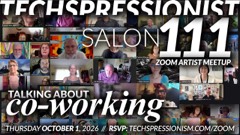
Another thing that we have done as a group, that without me, really, is this wonderful Co working time. That's once a week where people come together and support each other as we're making work. So these 2 things, I think, are very exciting to witness, and I'd like to maybe discuss any. Any- any sense that you're getting as an artist from this group or previous. I mean what I had experience previous to expressionism. As far as communities, artists, we're all geographically based, was in a school in a studio building where other artists have studios. But here we're sort of in this Virtual space where we're able to come on. You know, we're able to create community in ways that previously, maybe pre pandemic. We didn't have the tools to communicate with, and now we do so. I guess my question to everybody here is, have you experienced this in the past. Is this group resonant to some experience you had that was formative and help support you as an artist.
Techspressionism Panel
And how is this group? Maybe individually, it doesn't have to be up to the whole group. Have you connected with certain artists or certain ideas that have helped foster your practice recently? You know I'm talking about in the last 5 years or 4 years, however long. By the way, this is Tommy Mintz. Most of you know him, but he's the curator of this show. And also Hello, Brooklyn, along with some other curators. Here comes my famous computer graphics teacher from the School of Visual Arts. Rachel galman going back to the eighties. Anyway, I did want to share for just so, because Rachel just entered and welcome. So glad you're here.
Techspressionism Panel
To all of you talking about groups and community. Some in this group know about this group that I started with Rachel actually called picture element. And this was in the eighties. And it was, I know, that young people forget that there's no Internet, you know. And so some of us like myself, where digital pixels were injuring my pains. And I really needed other people. I could barely operate a toaster, much less a computer. And so we started to help each other, and that Weintraub was in this group. We came up with the name picture element with a square in it, and Cynthia Ruben was in the group, and some other artists was about 8 of us, I guess, and we met at each other's houses from like the late eighties to like, I guess, 94, or 95, and we showed together, and it was so exciting to be part of something new where you really had a reason to share, you know. Oh, I'm using this or I'm using that. And we went to. It was pretty hilarious because I look back at our pictures of talking to each other on rotary phones, these huge clunkers. And we had these huge computers. I was, you know. James was helping me set up things, but I had to shoot the burglar camera to get my images off the screen and take them to the gal, and you know, and I was so excited to have like 88 colors when the amiga came along, and I was like Whoa. And so it's very exciting time. But that community and meeting each other was, that's most is kind of such that I'd say, since school college, you know, that happened in college. But, I have found the same thing as you did with expressionism. I've been very impressed with the level of the work that is going on. And it's not just a group where everybody gets on from all parts of the world now, and says, Oh, I did this, or I did that. I mean, it's always great to share these things. But it's more about seriously coming from that earnest place of discovery, and how you're responding to this new age, both in subject matter and the way we do our work. So it's been very exciting.
Techspressionism Panel
Yeah, so that's my 2 cents, and whoever one else wants to carry on might be good to introduce ourselves to some people online, or even here might not know us. Let's see. I think that expressionism group was important for me, because it came at a time when I was just glitching myself by myself, like in 2,014 and 2,013 and. And discovering all these things, and not knowing anybody else who was doing it, and I looked it up and it was Patrick Lichty was named for the person who was on the Internet to have done this one of the earliest glitches and then I spoke with Roz Dimon, and she said, why don't you speak with Colin Goldberg? Because we have a group called the Expressionist, and you should join.
Techspressionism Panel
And I did, and life hasn't been the same since. And also, you know, you were. Another group. Thing that happened was the show code that was created in 95 kind of early. I know other people have done tons of things, but I curated that show, and it was very exciting to have Nina and her partner, Emily. Yeah, that had crowds around the block at the show but like 300 people, you know, I remember my parents came from Atlanta. My mother said to my father like, oh, my gosh! Has been an accident. Thanks for the encouragement. But it was a really exciting time, you know, it really was exciting. So Yeah. But then things kind of died 9, 11 shut a lot of us down. I mean the whole digital creative. At least the seniors of us who were at the top of our game. That was a real game changer for me, but we survived, and we come back, and I feel like there's a new blossoming now, even with AI is fascinating to me. I'm not going to be one of the leaders there, but I'm real interested in it.
Techspressionism Panel
I moved here in 1995. So this year marks 30 years that I've been here, and as my, and so, as my practice has evolved, the different kind of groups have participated have changed, too, and that's always fascinating. And also what you were talking about, how they used to be so geographically kind of tethered, and with the onset of the, you know, this big global pandemic our ways of communicating really expanded. And I met Colin, though in a physical show, you know, and we were in a show together. And that's when. So I'm kind of a newer member. But I was just so excited to see such a supportive group of people like, you know, international, you know and that you would. You're really harnessing. You know, these new technologies so that everybody can communicate, you know, be communicating together. And but a lot has changed since 1995. Because back then, yeah, no, no cell phones. Actually, though, in 1995, my dad, because my parents I grew up in a tunnel 7,000. They were so nervous about it. My dad gave me this brick.
Techspressionism Panel
And that was like a cell phone, and I was so embarrassed to carry it around. Oh, that's great to expressionism to me. Is he Emblem of cooperation and getting together and being there for one another. It's been a remarkable experience when I took oil painting class, and when I decided I was ready to move on. My 1st goal was, I want to meet one. I want to know one person at an opening. Then I became a member of Series gallery Supported, fantastic, unbelievable, and this group tops them all. The- the camaraderie, the joy, the support is- is amazing and absolutely wonderful. I'm at the opening here. Everybody is so happy, and not only for the board, but to see one another. It's a marvelous time I see a message on the zoom, just A little nerd being here. Translation, I think.
Techspressionism Panel
Oh, okay. Yeah. Someone was recently talking about getting older and being isolated, and asked, What do you do with your time. And I need to confess that I spend half my time online almost as much as offline, and that time is especially with groups like Expressionism and my poetry group. I mean, it's very intimate. It's almost more intimate than when not more than when you're physically together, because that's wonderful. But in some ways. It's just you expressing right on that screen right next to someone else, like thin skin space, they call it in religious groups, but thin skin, like there's just nothing. There's no breath or anything between you. It's just you person, whether they're in Australia or you know Guinea, or wherever, and that I find that just people say, Oh, I hate zoom, and there's too much communication. And it is overwhelming. I mean, I think we're all caught up in this war that we're in. But we are. We live in 2 worlds now, you really didn't. Even it was still your computer. We knew something was coming, but none of us like people say, Oh, Roger! So Techie had nothing to do with like knowing how to do email or anything. It's just we, I think a lot of us are responding to like the stuff that was Tvs and electricity. And it was coming. But who could project, I mean? And the Internet? I mean, we didn't even wasn't about that at all. We would mail each other things, you know. We did an exquisite course thing together. Where? How do we get it. Do you remember, Rachel, how we sent it to each other? Certainly wasn't the Internet? We didn't have one, you know, we emailed it was there emailing a library. And so I was using the Internet to download records from the library very early.
Techspressionism Panel
Hell, we would call. We look at it now. But it was. It was amazing then. Yeah, I'm thinking about Los Angeles in the nineties, which is where I was. In the late nineties there was this underground movement happening that I was a part of. Did you call yourself Silicon Valley, wasn't it? No, it was all underground. And yeah, it was part of the raid culture, the desert raids. And then in the city the city hadn't gentrified yet, so there were all these like warehouse parties, and there were a lot of like pop up galleries that were happening.
Techspressionism Panel
And that at that time I was working in dance and performance and performance, art and just starting to work with technology and cameras and video and all that kind of thing. But that community makes me think of this community as you were asking like, was there ever another time I think of that time? It's like this kind of golden era that was happening the underground art scene in La. And now I'm so grateful to be with the Techspressionist, and I think the most Pivotal thing for me has been the working group that every Tuesday. There's a place that I can go to and be present with other people intimately through Zoom, and have an hour that I commit to work on whatever I need to work on, and then know that I have this group to give feedback. It's that's incredible. Did you excuse me? But did you know Michael Gosny.
Techspressionism Panel
At that time he was like head of the in San Francisco, and he would take over a warehouse like you're talking about in the middle afternoon it's covered with weeds, and by the night it was a total wave, and that was a very exciting scene. Ross, and all sorts of stuff going on socially because of the Co working group when we had the Hello, Brooklyn. Yay, I said, Oh, Lord, I don't want to go out there alone, I mean. I know I live here. But and then, because of Co working, I met the Cynthia's, and they were also looking for a way to get out there. And so we met and took the car service out, and only because of Co. Working and the friendships have developed.
Techspressionism Panel
So I'm hearing some interesting parallels from like past times when real estate was actually cheaper. Right? And so there is a sense of there's a sense now of scarcity with space, physical space, and it's hard to have that generous camaraderie and physical space. But we do have this fairly mature digital space, if you will, in our mind right. And I'm wondering if that has yeah. Stopped people from feeling that sense of scarcity and feeling more generous, saying, like, you seem to have gone away in 2,001, this sense of me. And now it's coming back. I'm kind of wonder. What is it that has provided that sense of renewed connection. Is it the maturity of these tools that were developed for works? You know Zoom is a work tool.
Techspressionism Panel
I mean, even in the underground thing, to be in thing. They would call Japan and send something, and it would take, you know you get one real excited to get one little line transferred over. You know it was fascinating at the time, but now I mean what you can do and what you can share online with others. It's like you're in a studio together. But it is interesting that energy that the people have to do that working thing, that you can feel the energy of others, even though they're not right with you. That's kind of interesting. I don't know if that's what you were getting at, but a little bit. Yeah. And also like this idea of like having big old vacant spaces that you can get physically together with people. And that is that energy that we've seen 30 years ago we emerge now this space that we're gathering in again as a group of artists making.
Techspressionism Panel
You know whatever it is we're making. Yeah. But I think scarcity is a big point, and I remember Madagascar Institute. They just get these open spaces out in Brooklyn and put all these huge kind of circus like art events, and they were really amazing. And then you were talking about 9, 11, and I think, particularly for digital art. There was there been an interest in this kind of work. And then, all of a sudden. I think people just didn't know how to respond to what had happened in New York and the art world. I saw it turned much more conservative again. And it was just like, we just want painting and sculpture. We're, you know, this other weird computer stuff. We don't know what to do with it. And we didn't have tools like zoom then to kind of foster community. And so I think that to compare and contrast that period of time in New York to now, and not just because I know a lot of you aren't in New York. And that's what's really exciting about this is that back? Then it was just a small group of people that we were all trying to foster and nurture each other after you know this atrocity and still believe in the work we were producing. But now we have this expanded community.
Techspressionism Panel
Yeah, I mean, I think with the pandemic. The 1st salon was held during the pandemic, and it was myself. Steve Miller Osband Rosen, who is actually the 1st person that I found out that was using the term Techspressionism to describe her own word. So kind of the genesis of the group is that I reached out to her and said, Hey, what do you think about starting an artist group around this idea which led to? And she was you know she was interested in doing that. And then I reached out to Helen Harrison olive House, who also was enthusiastic about it, being a scholar of abstract expressionism, and she saw it as sort of an extension of that to some degree. So our 1st salon was, it actually invited Steve Miller, who I, who I worked for as a studio assistant when I was an undergraduate, and Patrick Lichty, who I met in graduate school. We were both doing our mfas in Computer art at Bowling Green State University. So it was. The 5 of us. Patrick, I believe, was teaching animation in Abu Dhabi at the time, and you know there were 3 of us that were on Long Island actually, before the rest of us were on Long Island, I believe. Yeah. And so I don't think this would have happened without the pandemic. Honestly, like everyone was quarantine and people started to show up from all over the place, and I remember Davo saying, You know, hey? I feel like I found my tribe here, you know, and that's when I thought, Wow, this is really interesting. And when you brought up Joseph in the beginning, so, like I had done a project back in the nineties, I actually moved to New York in 94, and lived downtown for about 5 or 6 years, and I did a project called Ever Beta, which was a content network. This was. Everyone was on Dial up. The only online video was real video, and you know, it was art. It was artists interviewing artists. But it's also Oh, it's interviewing artists, musicians, interviewing. Like all different types of creative people, the bandwidth wasn't there yet. But you know, Joseph, at that point introduced me. This idea of social sculpture, which is a concept developed by Joseph boys and it only came back to me after this, this group really started formulating. And I thought, Wow, like this is an opportunity actually sort of exert social change to some degree by encouraging collaboration and seeing like especially seeing, like, you know, artists who've been at this for a while, and might have known each other through various exhibitions or academia. Come together, and you know be sort of reunited like I got the chance to meet Claudia Hart yesterday at our show in bit forms, and she's like, Oh, I know Joseph, and I know Michael. Reason all these people. And you know, and we were discussing expressionism. And it seems like it actually is a fairly small world of people that have really been at this for any extended period of time. So it's really interesting. And seeing other artists running with their own ideas like a Co working group. And now Cynthia, Beth Rubin is organizing our 1st international show. Leading arts to Uzbekistan, so can we take a moment to encourage people to take note of that show. Cynthia might be on right now, and hoping to absolutely raise awareness of our upcoming.
Cynthia Beth Rubin
Hi. So yeah, I'm here. A small group of us are going to Uzbekistan, to the Museum of Contemporary Art and building on the idea of community. We also wanted to have a community show. So we do have an open call right now for digital screen that the museum will be providing for us. And I will put the information about that in the chat, because this is kind of the 1st foray into an international area. We limited the number of people who are actually going with physical work. And then we're supplementing and building the community. So I'm just going to put this in the chat, and I would encourage people to apply, and then it will be curated by all of the artists who are participating, and the director of the museum.
Cynthia Beth Rubin
So that's it. The links in the chat. And I just put on Facebook today. So we're asking people to submit in Powerpoint format so that it can be viewed by the director easily from far away.
Techspressionism Panel
Cynthia, what's your deadline?
Cynthia Beth Rubin
The oh, good point. The deadline is July first, st and what we're asking for is either 3 still images or 1 15 second video extract. And it's because it's going to be in a museum in a space that people will be walking through. We want to be able to show as many people as possible and have the screen be changing with different work. So we have a template for the Powerpoint. If you don't get it perfectly. It's okay. We'll change it if you make it in keynote or Google slides, just download it as a Powerpoint and upload it, and we'll fix it, or we'll have your email. I mean, this is not Stress situation. We just want to be open.
Techspressionism Panel
Have a guest visitor. Oh, my gosh, wow!
Cynthia Beth Rubin
Techspressionism Panel
Yes.
Techspressionism Panel
July first, st and the show is gonna be September open since late September.
Cynthia Beth Rubin
25, th I believe.
Techspressionism Panel
Yeah.
Cynthia Beth Rubin
Roz is one of the artists who's going. So she if you, if you're in the space and you're lingering, you can ask Roz questions.
Techspressionism Panel
Yeah. Absolutely. I didn't even know where Uzbekistan was when I 1st heard from Cynthia, and I went. Well, it wasn't really on my bucket list, but now it definitely is and real excited about it. You know, it's right in the center of the old silk road and The steps in the in Eurasia. And it's I'm reading a lot of books that some of the other people in the group have recommended. It's been fascinating to read about that time and its history. So we're real excited, Jake. I wanted when Colin was talking about expressionism.
Techspressionism Panel
And one thing I love, and Helen Harrison. I love how she set the tone for our group as one of style that we all we each bring our own, not style, but we bring our own? How would I say it, Colin? How did she put it? Yeah. So the initial definition was sort of a mashup of technology and expressionism from the Oxford Dictionary. So it was an artistic style in which technology is utilized as a means to express emotional experience. Not impressions of the outside world. So in our 1st salon 2 important changes were made to that definition, Oz said, Let's just get rid of this end part about it not being impressions of the outside world. Because, what about figurative work that can involve technology? And Helen said, let's strike that word style and replace it with them. And so, like, you know, movements of the past, if you think about it, are bound by a certain style to a large degree. You think about surrealism or cubism, and you can tell how stylistically the different artists are related, whereas I think her suggestion of using the word approach really opens it up to a much broader base of any artist using technology or personal expression. So I think that's what has actually given this legs. And I was actually speaking with. You know, about this recently?
Techspressionism Panel
To another artist, and I see it as sort of like an almost like an onion. Where you know, it was actually my conversation yesterday with Claudia Hart. And we're talking about the idea of community versus movement, which is movement, is something that I'm very hesitant to use as a term, but I think the onion piece of it has. The inner part of the onion is this community of people that are like showing up at the salons, you know, involved in physical exhibitions. And there's this outer layer of people using the hashtag, which is how a lot of the artists are located. Renata is now the Instagram curator, and she locates people a lot of times through the use of the hashtag. And right now there's, I think, 81,000 posts on Instagram using the hashtag from artists all over the world, so that outer part of the onion is actually very interesting to me, because these are people that relate conceptually to the idea that aren't necessarily participating in the activities of the group. So you know it. It's Yeah, and it's and I mean, you know, for me personally, it's turned into something that I could never have anticipated. And it's amazing to see. You know, all the artists here today gathered together and building this community I'm actually thinking of like bulbs and how they multiply underground. And then all of a sudden you have more sprouts and more plants I'm thinking of, like our international expressionism nodes if you will, right. But we also have this group that's within, you know, within and without sort of Venn diagram with Digiana.
Techspressionism Panel
Right? So do you want to talk about like tech person is a and what's going on this group. But like, I'm super surprised. I'm here in today's like, very like, you know, like central side of like a conversation. And I, I say, thank you for bring me to here. Right? So this is tech person is the you know tech person is, and bring, you know, even like my organizing like a vision other side of people together. It. Anyway, this is very wonderful like opportunity for me. And talking about the digital lines. 1st of all, introducing my service my name is Sunjing, and I know.
Techspressionism Panel
For group is my organizing group name, and you can see the digital like a rated artist show in the corner side, and is almost same meaning so. But why, I you know, like could do a conversation like you know, like cooperation between the tech person is, I mean, I think digital and tech person is gonna have a common side. Yeah, definitely, yeah. Because tech person is a definition is using technology. But like you spraying the humans, you know, like inspiration, or like a like an emotional thing. Also, technology, right? The digital. I mean, it's also, you know, like using a digital and like a non digital effect, they definitely having something like a rich emotional like, you know. For me it's very cooperation.
Techspressionism Panel
The thing about approach also that I've been thinking about lately is, I heard someone say, Oh, this is a different! It was in the New York Times. Oh, this is a different kind of show. Where the artist she is. She is not every she doesn't have like one period of work. She has, like, you know, 18. And you know, we're in a world, I think in some ways to expressionism opens it up to this fast growing moving. I mean, so much is coming in every day, and you can react to so many things that I mean. I know I probably have. I have this coffee cup that says, Why does Picasso, you know, get 9 periods and women only get one. But you know what the fact is, one of my little jokes. But you know the truth is, yeah.
Techspressionism Panel
But the truth is that when I look back. I ask the curators to get out there and really do the digging, because there's a story that's happening. But people are not just I mean, it's okay if you stay with one style and you just obsess, I mean, art is obsession. But I know for me that I've had a lot of different. Here is, it doesn't mean I'm not focused. It's just that I'm changing. And I'm responding to a changing world. And I think the fact that we have an approach. And we're not just like the Futurists, you know, which you could. You know. They all have a kind of style. I think that's a kind of freedom and new whole thing. That is, that we're opening up here in a way, and yet serious artists talking about serious discovery. I mean, I know that I'm glad we're a friendly group, but it's certainly not therapy. It's serious artists. I've been very impressed with the level of the work that comes in, you know, to the group.
Techspressionism Panel
For the most part, I think that's interesting that we're using this technology to create the work. But I think it's in a way that questions the technology and doesn't just say it's all great, right, you know, taking it apart, making glitch out whatever it is that we're questioning the underlying tools that we're using, that, you know, come from somewhere else, actually come from the business world in a funny way. One of the other things that I want to return to. And what you're saying. And Colin brought up is this idea of the language of Techspressionism, reflecting impressionism and the Impressionists right? If we look back on that group were 1st of all.
Techspressionism Panel
The people who weren't exhibiting in the official salons in France at that time the government said, Hey, here's the official artists, and then the ones who weren't in with the polished style of the time making this sort of more revolutionary work were the Impressionists. But who were the Impressionists? Is another question. Is it only those artists who participated in the those shows, or is it, or is it the and some very prominent like? I think I was not in that show. I'm mixing it up, or is it use of the style that defines an impressionist. Not all impressionists in that show. We're using that same style. And I think thinking about the wide Sweep of impressionism, and how that redefined, how artists thought of themselves, and comparing that to, I think how expressionism can allow us to redefine, how we think of ourselves in relation to, and people saying, Oh, you know, painting is the way that art, you know, defines itself in the.
Techspressionism Panel
You know, galleries here in this neighborhood 97% of sales is painting right? What is it that we're? And so our comparison is where that salon, if you will of refuse, but not just that group if you think of our internal. So here, maybe as a comparison to that, there's all of these other artists that are using the hashtag that are using these tools and ideas that are well beyond it. So I think it's a really interesting comparison to think about the maybe inner circle and outer circles, or whatever you're saying, and compare that to movements and groups of the past, when you were talking about the onion and the outer layer is Zeitgeist, too, and I think that this could be a Zeitgeist moment. I remember several years ago, or it was just like 2 years ago at the Metropolitan Museum. They had a surrealist show representing all these works that we weren't familiar with from the global South.
Techspressionism Panel
And so you know, the one thing with hashtags that represents that there is this Zeitgeist moment where people are tapping in. To you know the expressionism that is possible with these. You know, industry technologies. And also you know that more and more. When I 1st quit painting and started working digitally, I felt like I just had to be working virtually, basically. And I have increasingly adopted a very hybrid approach that you call it digital, that you know the analog to digital. And I really do feel like there's a Zeitgeist moment. Where, whether people are, you know, in this group or not, they are kind of connecting to these themes in a way that is relative.
Techspressionism Panel
Yeah, we also have the notion of self definition. Yeah. In other words, these impressionists were labeled from the outside, we're more convinced from ourselves. Yeah, that self identification aspect is something that to me is a little bit of a differentiator, and I think it's an important distinction in that. There isn't a critic or a curator, saying, these are the Techspressionist, and you're not. And I've had artists, you know. Ask me so. How do I become a Techspressionist, and we have on the homepage. You're a Techspressionist when you say you are, which is something that I actually stole from myself. Identification. Where, if you identify with concept and a lot of times from the hashtag people like oh, that's a cool word. I never heard that before, and that's the basis of the connection. Initially.
Techspressionism Panel
What happens in the Expressionism Club stays in the texting. The kind of dialogue that we have like that we come up with topics, you know, for the our zooms. Our monthly meetings now used to be bi-weekly during the pandemic, but I was having a conversation with an editor from Smithsonian, and a painter friend of mine recently Paul Trackman, and I was so I mean. No, this is a few years ago, and I was like, Oh, my gosh, Paul, I mean the amount of layers that I can put in a digital. I still call it painting. I'm still doing still paintings that are like layers and layers and layers and layers and layers and layers deep.
Techspressionism Panel
There's just no end to how much can go into this screen. And I said, and it's amazing, he said. Well, Ross, if you ever looked like, if you look up close at an oil painting. You'll see you can see a lot going on in that one little, you know lots of stuff. So I love that kind of interchange between history. And now, like we come from a history, and I think that'd be a good thing for us to keep bridging into a little as we go further, because you can't just come out of nowhere, you know, tying ourselves to the larger historic moments, and comparing and contrasting as we are today, like, what's the difference between.
Techspressionism Panel
You know? Maybe a Futurist and a tech presence. But I just think that kind of dialing is- is so good because we're all we're tied together to history. And that's what makes a movement, you know, if you have to have that, I think that's some broadcast like your garden of earthly delights.
Techspressionism Panel
Oh, my gosh! I saw it in the soft be show was so fantastic, this animated, erroneous how do you say his name? And but it was so all your own, and very it was really quite pivotal, you know, but it was nice to see something in store. Reimagine, reimagine remixed the garden of earthly Delight still, with us always. Yeah. Today I'm very interested about like everyone talking about like a like tech person, you know, like a robotism, or like something layer inside of like how people see the like artwork thing, because, you know, I'm from Asia, like I'm actually, I'm born in South Korea.
Techspressionism Panel
But I used to live in Japan a long time like almost 10 years. Then I come to New York. Then I realize there's so many like a different approach to when people like, you know, like handle like a digital. Or when people see the artwork like, you know, for example, like, like basically Japanese scene, people think about the digital is kind of like a like reason. Single is like thousands of like reason, you know. So they don't put like a digital content. Also, like a layer.
Techspressionism Panel
It's sort of like, just a fear of like, just a reason, because they're basically like a personalities from the like a naturalism. So they say, like a digital naturalism. They don't see it, or just like not like. But when we see here, like a digital side, like people say like when they're like a digital content, painting always from the right expressionism. And then cubism. Then, like a pop, art scene and digital scene, like people see like more so and connected as part of artistic lineage in some other places. It's not like Shinto, I mean, correct me if I'm wrong, but I think you know my understanding is that there isn't necessarily a distinction between things that are man-made versus natural, that it's all natural. So I think that idea that maybe there isn't really a boundary like we're immersed in a digital society culture at this point, you know. So like even artists who completely work with paint. Ultimately, they have to take digital photographs, publish it on this global telecommunications network right to get their work out there. So it's embedded in so many things. And you know, when you brought up Shinto. It kind of made me think about that concept. And it's really interesting. It's also interesting that it's not something that Expressionism is not something that is visibly identifiable.
Techspressionism Panel
It's more of the person identifying themselves as. And that's interesting to me. It's not like, Oh, well, that's definitely expressionism, you know, it's coming from that's expressionist and a kind of even visceral, you know. Connection. Yeah. And also, like, I think, to like, today's our nowadays, world is very interesting, complicated world, because I also do like side job in the tourism, in Metropolitan Museum or Korean people and Japanese people. So almost 2 years, I've been doing tour tourism, and I always notice Metropolitan Museum. They do a really good creation. There's like special exhibition and event.
Techspressionism Panel
But recently they what they do is more both side of like Asian art, or like a rock. Broad people, you know, like African star art, or like a more, you know, like not famous countryside art, or like I'm sorry for to speak, but you know, but I think, like here. Like American, based like a like a Western art. History is more western, like logical approach that like from the Moma. And you know, like they have, like, you know, like inspirations, and like tourism, pop art, or like more western side. But nowadays they approach like outside or like Western side. But for me is literally weird. Because here's America. But why I see my for you on park board, do you Metropolitan Museum, or Yc, you know, like, so where's going on? The here's, you know, like Western, basically like Art Main Street. And what people think about the like a new digital form, you know, like for me is, we're really something complicated, like a like she was in New York. What is the mainstream? What is the mainstream? That's a good question. It feels convoluted and difficult to parse. Kind of what is mainstream anymore, just like it used to be. And also it's difficult to find or kind of understand Counterculture, because counterculture, because we're so mediated, gets kind of subsumed. And then we see all these brands who have kind of adopted the aesthetics or the style or the language of counterculture. And you're like, wait does counterculture. And what is mainstream? Yeah, it's gotten very complicated. And then in, you know, museums and their curatorial efforts, I mean, I think it has been important for them to expand outside of the Western Canada, you know, as the Internet has connected us globally, we should be seeing that aren't represented in these institutions, you know.
Techspressionism Panel
Yeah. But then it's like, Oh, well, who you know, there used to be Andy Warhol, or there were these people who were as famous as the Beatles. And now it, you know, it's more diffuse. Yeah, you get 5 seconds. Now, yeah, yeah, it really does redefine fame and all sorts of things. The democratization that has come with this movement is amazing. You know, and yet and yet I do still feel we're kind of rising to some new visual language that we're all a part of.
Techspressionism Panel
And kind of suffering from, too. I mean, you know, it's English. I don't know. I always call it the new Gutenberg Press of imagery, but I think we're there. I mean. You see so many more images every day than used to that I couldn't wait to go with my parents to a museum and see art. And now I see so much work, you know, and I feel like what we're doing is speaking to that in a way, the community thing is another way to give that some gloom and give us some meaning and storytelling. Of course, we're all talking about that a lot, making stories from images of images of images and from community doing these images, because otherwise it's just a big. It's like a big morass, you know, chaos. So I think artists who are in this field have a huge role to play, you know Of I don't know. I call it sometimes the new Shanan's. It doesn't mean that your work has to be about peace and love, but that but that it is a way of us helping usher in this new visualization that is, is taking over really, in a way, in a new kind of hieroglyphics, maybe 110 years ago.
Techspressionism Panel
And I think what brought that about was technology of transportation and movement, of people and goods around from, you know, Asia and Africa to the European cities, where artists then saw these masks and incorporated them in their work very unfamously. Right? Today are we having a similar expansion of our Visual knowledge base, if you will, that we could then make sense of as artists in this new mode of transportation that's now just images or just digital makes sense. Yeah, to make meaning of Life right? To understand art offers us this abstraction.
Techspressionism Panel
And right now we're missing ritual. We're missing. We're missing. We're missing gathering, we're missing community. And so I feel like people are really turning to art, and it can become like the new religion. You're talking a lot about religion. I feel like I feel like people are falling away from religion. So then they fall into art. And that's where art can really like. Provide probably a new space or a new way of having that connection and understanding of what it means to be a team.
Techspressionism Panel
That's kind of fine. Yeah, I mean. Well, I think this goes until one. We're up till 1 30 on zoom. Yeah, I've been seeing that there's there are all sorts of things coming going on in the chat, so I can't wait to hear from the audience. But the one thing I was going to say, too, is that I think sometimes we were talking about lineages and often art history, and then kind of New media digital art. Those timelines get bifurcated. And certain people aren't making those connections between like Saul Witt, you know where he's giving instructions that humans are abiding by. And then, you know, artists Roscoe, or various artists from that time are typing the instructions. But it's a very similar practice ultimately, and that you know what has been exciting is to see these convergences where people from outside of maybe this community are starting to understand that we've always been part of, you know this artistic timeline, and that our artists, I mean the invention of 2 paints revolutionized painting. And really, that's why the Impressionists were no longer tethered to the studio, and they started thinking about optics and the impressions of light and atmosphere, and so that revolutionized its science too. You know Einstein at the church Of the century, where people are, you know, I think Cubism kind of developed out of that thinking about dimensionally time and space outside of Newtonian frameworks. And so, you know, art has always, you know, and of course the Polymath, Leonardo da Vinci, you know where he is already building a robotic night in like 1492. And so to think that art and science and technology and culture have ever been something that we're not linked. It's so absurd. And it seems like we are a natural outgrowth using the tools of our time to respond. You know, in this emotional way. And so, instead of it being some kind of cold, hard, you know, technology just for capitalism and industry. We redefine it so that it can actually Resonate in some kind of spiritual way, too, which I think is important.
Techspressionism Panel
I mean, yeah, I think to expressionism, that's a name on something that's been happening for a long time, you know, not even just with the timelines of the people who are participating in this project, but going back before computers and think about photography was viewed, as you know, an outside and photography galleries were segregated just like digital galleries are segregated. And eventually people like Cindy Sherman decided, I'm an artist, not a photographer and happened to use the camera. And I think we're, you know, moving in the direction where the technology isn't the important part. It's what is said with it. All right, let's hear. What are y'all thinking?
Techspressionism Panel
So on the chat. We have some messages. I'm going to start up at the top. Hello, Vernada! Hello, everybody! Hello, Arielle! Hello, Cynthia! Hello, Marilyn! Patrick Lichty said, there have been many communities in digital art from the ting, rhizome, etc. In the nineties, and happy that it's another great group in the tradition, Ariel said, I believe that groups like these are coming back. You could see them in discord. Right? It's another online art community based in spaces beyond zoom. Right? And I, absolutely, we're not tethered to that one thing Co working space registration. Yeah. Are there questions from the audience that you could raise a hand, and, you know, unmute yourself if you want. Oh, we have a nice typed in thing here. One last thing, Tintin 23 x said. My question, for the panel relates the to the something, the use and function of nfts. Oh, it just disappeared again.
Techspressionism Panel
And prominence since 2021. Why do you think their use as a digital provenance has not been fully implemented and or accepted for both physical and digital works, especially for those mediums, sorry video art and digital photography which have long lacked uniqueness. That's in quotes, as described in Walter Benjamin's essay, the work of Art in the age of mechanical reproduction which we all love. So any ideas on? Why, that nft technology has not been. Fully embrace. Is that what he's saying, is there, is there? So this is an interesting thing. I actually think there's always this dark side to technology that we're kind of pushing away right. And whether nfts are this connection between the dark and light side? I worry about nfts being used as money laundering tools, which happens regular art right? It's very suspicious. So why has the provenance of nfts been not fully embraced? Is this something that we're Yeah, I mean, I've been participating since 2,021 on different blockchain networks and working with curators and being involved in shows. And even, you know, mention some of my own work, because I am generally like, I think, all of you. I'm an early adopter of things, if not technologies. Also, you know just this idea of new ways of kind of Legitimizing, you know, a work. And I read photography, even etching lithographs, I mean, these were all things dealing with multiples. And so I have been selling digital work, for, you know, over 25 years as limited editions, and I'm ethical about it. And I, you know, don't print more or produce more if you know they're sold out.
Techspressionism Panel
But I think that still has been like with any kind of new technological art medium, difficult for certain collectors or certain galleries for people to just either understand or parts. And so nfts what I found for a lot of young digital artists particularly, who are working, you know, day jobs in industry because they have to support it, or those of us who teach. You know, we always have to have 2 to 3 or more jobs to support our art practice, because it has been more difficult to monetize this kind of work. And so I saw that, as you know some new possibilities, but there have been some outrs of it that are more feel more nefarious, and that has been one reason why I haven't just fully like I'm going to put everything in the blockchain, because it just seems like, Oh, it's going to be decentralized. But then, you see that it's actually reflecting some of the negative things we've seen in the traditional article as well.
Techspressionism Panel
Yeah, I mean to me, like, I remember when I actually learned how to mint through. One of the artists came into the group Andrea Bonaceto, who he created an nft with Sophia, which was a robot. Handsome labs, I think, and some robots right and to me, like the nft phenomenon Upends the traditional economic structure of the art world. That is, the artists were the 1st ones to understand it, and, minting their own work, allowed them to sell directly to collectors and circumvent The gallery system right? And then gallerists didn't really know how to handle that like, do they meant the work?
Techspressionism Panel
How does it split, you know, and the splitting, you know, happens mechanically, just like the royalty payout happens mechanically through a smart contract. So I feel like the ability for artists to interact directly with collectors. You know, is a threat to the art world as it stands. And that's 1 reason it has been adopted. And also one thing that I think is really interesting about the Nft scene is the majority of collectors are artists, like artists, that sell work, you know.
Techspressionism Panel
For the most part, take it and buy work of other artists, especially on where the work is affordable. And I think all of that. You know. The only reason that everyone you know the sort of mainstream heard about nfts was because of people, and the only reason they heard of the people was because of the number of zeros after, you know, in the price tag of the work. So that's when like, you know, gets headline. However much it's sold for. And then, all of a sudden, you're like, what is this thing, you know. And then the galleries and the auction houses started taking note of it, which is. And I'm so excited about the prominence idea of it. Yeah, that you know, you've got a digital stamp in the world of digital that says this is one of 7 of this piece, and it gets prominence. And of course for art historians. That is key absolutely key to any catalog that's recognized.
Techspressionism Panel
So I was very excited about it, and I got in the Nft. Space, found it complicated to do, but I got into it, but then I also got burned a little. I mean, literally, I had a few pieces taken, and I just I kind of retreated in the commercialization of it that anything can be. You can digitize your football and or your football cards, or it's become so commercialized quickly that I think it lost, that I hope it comes back because I do think that the whole thing of that provenance of the nft is really hugely important, but I'm tepidly. I'm going in there kind of tepidly, you know, one at a time, I mean with Mauna, which Carrie and Joey are here. You know. I trust them. I want to work with them. I'm hoping maybe I'll do one with them, but I'm just cautious about it, you know, because I think we are in the vanguard in the front of a medium. That's it's got that is important. And these pieces are worth something, and I you know you could do. I think maybe I'll do a whole new series and do a really Inexpensively on tests. I also like that idea. But I also how do you do that where you have sold pieces for thousands in the art market? And you know it's for the artists. It's kind of confusing, too, how to do it. But I think it's still a great exciting concept. I hope it's its seriousness back. Well, like Moma's acquisition of Rafiq Anadal's work that was exhibited there the AI piece. And that's a major institutional purchase of an nft. So that's like movement, I think, in the good direction, and I thought was pretty brilliant. I thought that whole. You want a thing a day, and I thought that was a really cool, cool project, you know.
Techspressionism Panel
It's good to be cautious, and it's good to be slow and thoughtful, and there's time, and it's not going away. Yeah. There was a Grant union that sold yesterday on Tezos for 20,000. So that curation, Joey, what is it called the paid box curation that's happening right now on Tezos is a step forward and good, and just like having the mass adoption of museums showing up, and I think that it's a powerful thing to be able to tie your artwork directly to the blockchain. And when art is like around 60 to 70% forgery are happening. And trad art like it's, it's a much better way to have art not be Forge and to link it to yourself and to give it that provenance. It is really difficult to get on to, you know, to the onboarding process solved. But it's coming, and it's like we had that big burst, and then 2,021. And now it's just kind of like slowly growing, which is good. And I think it is part of our future. It's not going away. And the Twitter community is still really vibrant. I mean, I know.
Techspressionism Panel
I think what also has changed is our current political climate. And so there's certain spaces that once felt like, you know, open communities for artists, and particularly digital artists, to convene. And now there's a level of toxicity there. And when I still check in on Twitter, I'm going directly to that community and seeing you know what's selling, and there's something still vital there, even amongst a more kind of Toxic user experience. One other thing about nfts that I think, is an important distinction that a lot of people don't understand, especially people who've never worked with nfts is the fact that it establishes a royalty system for visual artists so like you as an artist selling, and then it exchanges hands and becomes a secondary market piece. You automatically receive generally a 10% royalty on that transaction through the use of the smart contract. That's why a smart contract exists. So like, you know, this is also something that threatens the traditional system in that a work can be sold as a secondary market piece at auction. The artist received 0 Ledger. Yeah, there's no ledger. Yesterday I went to the beach and 11 pieces of my work for dance prompts this AI generative piece that I made on impromps sold on secondary. And when I got home there was. And it's like, that's amazing. That's nice. Yeah.
Techspressionism Panel
Shaves hands again and again and again, like Ann's fault or spacious right? She made this giant collection. And it was affordable. And then, now it's being traded like people, trade collectibles. It's a collectible. And that's pretty nice. And you can own a parlor canvas like. It's so amazing to be able to own these artists to own their work well. And I think that's what also I really appreciated, particularly the Tezos community. And early on, you know, I think you were saying this, Colin, that it's also artists collecting each other's work, and they're is an accessibility like there are certain things I'd never be able to afford in certain kind of gallery context. And you know, because people are doing multiples or additions. And that's that has been something I've really appreciated, too, you know, speaking about communities, yeah.
Techspressionism Panel
And it is a multiple on an nft totally separate from your multiple of that same work in the fiscal arena? Or is it, or do they relate like, if you have one of 20 of a piece that you created digitally? And it's and you numbered it like you were saying. You always keep track of you, too. And then you put it on the blockchain. Does it start at number 8, if you sold 7 of them? Or is it a whole different ball of wax where it's not about the physical one? I think you can determine that. And I also have sold physical objects that are like, you know, metadata. It's linked to, you know the physical objects that all of that is documented, yeah, it's up to you. Yeah. So it's I mean there. So you have a kind of Autonomy or latitude that again, in other contexts, when you're working with 3rd parties, or whatever where you might. You know galleries, or whatever where you might not be able to.
Techspressionism Panel
Yeah, interesting. It's also the new social in my mind. It's like the new social platform is the blockchain, and you can send signals. You can send gifts, you can, you know, like I can send an nft to you just to be like, Hey, there's not like thumbs up, thumbs down toxic behavior attached to it. So it is like a new way of being in community. That's great. That was a great question. Or are we at time? Well, we could. We could start with closing ideas. Tbd. Oh, follow up question.
Techspressionism Panel
Wait! It just moved. We're getting more questions coming in as photography and lithographs were treated as non-art because of their creation being part and parcel to a mechanical or machine use in their creation. I'm sorry I'm going to turn around and ask this to the audience, to our panel here more directly. So Tintin followed up with tintin. 23 x followed up a follow up question for the group, as photography and lithographs were treated as non-art, because of their creation being part and parcel to a mechanical or machine use in their creation.
Techspressionism Panel
Where do you see the use of AI as a generative tool. So we're comparing our sense of photography and lithography becoming. But our over time is that something you see happening with AI or it's different. It's what 1010, 23 x. Still, a lot of the artist decision in charge of, I mean, you know you go. Oh, I work with a group, and you know they have a team. And you know you look at the ateliers and the Ring Clubs, and there's always studio ateliers and people who worked for. It's still the vision of the artist putting something together. And if you're working with AI and you're training your assistant.
Techspressionism Panel
I still think that I think it's really fascinating. I'm curious to see where it's going to go. Jeff Coons has like 100 artist assistants in his studio, you know, making sculptures whatever is that any different than AI? I don't know actually touching the work, and whether you like it or not, it's not even the point it's like, is it art? And yes, I mean, I think so. Yeah. Yeah. And AI Is- is kind of Infused in everything. Now that and what I mean by that? I asked my students, beginning of last semester is like, how many of you use AI? And this was undergraduates, and only 3 of 20 raised their hand. It was like, actually, you all do because you're using Photoshop, or you're using word, or you're using Google. And but a broader conversation is AI is this big umbrella term? And so there are many different Applications of AI. And then there's Agi and all of these things. And so you know, I think literacy about these things is really important. And then I think artists have always worked with.
Techspressionism Panel
If not new technologies, new concepts, or, you know, burgeoning things just in the, you know, the sociopolitical universe. And so I think it is kind of for those who choose to. I think it is important that we're participating because I teach in a school of engineering. And I don't think it should just be the computer scientists or the engineers or programmers who are making these decisions or kind of creating a trajectory in the future of how AI would be implemented. I think artists should be going in and kind of, you know subverting it. Or, you know, mashing things up in ways we haven't seen before. Yeah, absolutely.
Techspressionism Panel
Especially like, you know, I did this interview with Sasha Stiles recently, you know the idea that system can be trained on one's own material. I think that's a lot of people, you know, basically the mainstream consumer or consumer. They don't even think about the idea that an AI might not be actually scraping the Internet and stealing everyone's stuff. It could be an artist feeding all of their past material into this complexity, you know. Yeah, it's only as good as your questions. So Yeah, so I think it's fascinating. Really thinking about like, you know, like AI thing, and I always think of it. What is the meaning about the creation like even making my art, or like doing activity, you know, like or you know, because, you know, like more like just few years later, maybe AI more like a more intelligent like robot can make anything right like people don't need to make, you know, like creation or new new thing. So I think there is one of the reason why nowadays, recently, especially young people like even America, Korean, Japanese people, so many like they have anxiety like depression, you know, like I almost every day watch like YouTube, so many suicidal in Korea, you know. They just stop in their house.
Techspressionism Panel
And they don't have any motivation to work and just scoring their phone in their room, and just like down, because they don't have any motivation to like, you know, because AI is gonna make everything here in New York like most expensive, like a like a payments. Job is the second job is a therapist like safety, because sometimes super depression, I fear like, why are you really in New York is like this existential threat. Then, I mean, like, you know, like he's super because it's good. But you know, like, for example, today's conversation, you know, like almost every day. I just talk in my house.
Techspressionism Panel
You know, and like, just you see the YouTube, and just play your game. And it's very fun and like comfortable, but sometimes I have no motivation in my life. Why I need to go outside. Why? But like today's conversation, I'm super happy, because, you know, like I, I use my brain super fastly, like trying to understand, like a conversation rivalry, you know, like there's energy and like physically. If like. So, I mean this really important to enjoy about creativity in like nowadays. AI growing. And I think we need to accept our weakness also. Sure, you know, like something. We miss our memory. We miss something this Community, you know, like so like feeling also, still, be your humans. I think this is kind of very important thing. I actually think you know, you know, in the end, the majority of the ways People in general are affected by AI. Isn't artists like Sasha style trading around systems. It's Meta Google, like the biggest corporations in the world using AI to affect the population in a commercial way. And that's Frightening, you know, no one can deny that's frightening.
Techspressionism Panel
Well, I always like that going back to the word press thing. But when it became, when words became more interesting again after being so democratized, you know, and kind of ugly in the 1st days, because there used to be these beautiful illuminated manuscripts, and only for the few, and mostly in churches and things, but then, when it exploded, and then the time of Shakespeare. And then, when people started sourcing Bibliography, kind of things, and this is something Christy and Paul talked about early on when I was doing these pieces, these diamond state pieces I'm doing that. She recognized. That made me think about it, too, is when you annotate and you include others like, I don't need to draw a ship even. I can go get a ship and put it in my opinion, and mix it up and mash it up with all the things I do. But I source I always source, and I always have an information source. Now, if you go to AI, I don't know it would just I mean, it's so infinitesimal about how much is going into AI. But I do think there's something about that community thing when you do a piece and you trickle out like when I'm doing one of these diamond scapes I call the museum and say, Look, this is going to be part of a nonprofit pieces, but it was paper by grants.
Techspressionism Panel
But I will source you, and people will know that civil war piece that you have is from your museum, and you get a dialogue with people, or you know I called somebody in Australia and said, I want to use your DNA. I can draw, but I didn't need to draw it, so I want to use theirs. And they said, Yes, and I don't know how that kind of works. But for me doing these in pieces with a team, a small team. Also working with artists and saying, Oh, can I use this and that? And you can making people part of your process and giving them a credit? You know, ego is good in some ways and not in others. But I think I don't know. I just think that's worth thinking about how we work in community and sourcing each other in a generous way. It kind of makes the web go out in a way that brings everybody.
Techspressionism Panel
You know. It connects you in a way, and it's not just. Oh, this is my piece where I stole everything from everybody else, which I think is I mean, I mean Picasso and everybody else said they stole. But I do think this is the kind of dialogue that is so great to have. You know. I don't have the answers, but great artists. So we have 10 more minutes. We have one more question that just popped up. I think it's an interesting one, maybe to finish out the panel. Ariel Barron Robbins asked question for the panel over the years.
Techspressionism Panel
Have you seen any shifts when it comes to art groups like the Techspressionists. Has there been a time with many, with much fewer, a bigger question, why do artists find themselves in these salons? What benefit does it give to artists. Everything? Here we are. We're back where we started, the benefits of community, the benefits of interaction. How many of us, I mean. I will sleep myself, picked up notions and ideas and things I might want to develop or ask more questions about.
Techspressionism Panel
Have a story to tell. Yesterday, I mean the other day I met Erin Co. Who's here in the audience I told about laser. She came to laser, and then she talked about this inflatable, that would be perfect for- for gamma time. Today I walk in. I talk to Carrie and Ginger, who said she knows that she's going to be setting up this inflatable? I said. Inflatable. Does she know, Annie? I just met, and now and now, on June 29, th At in the morning. We're gonna be setting up downtime in the inflatable. And that is community action. That's sweet, awesome.
Techspressionism Panel
In 29. Think we have people in person that haven't said anything. They're hanging out anything.
Techspressionism Panel
I have a question. Yes. How does the community that you're involved in? All of you are wonderful artists, the ones that I know your work, even you, Ross. How does this community change your art?
Techspressionism Panel
I think it does. Yeah, I mean, we share techniques. We share approach. Sometimes I'll see how someone's doing something just on their iPhone and go. Oh, wow! They're just making art on their iPhones. Pretty good, you know. What are they using? Especially some of the younger people? Well, I mean, you have to throw baggage away as you get older, you know, so I don't know. I think it's sharing a lot of somebody else in or yeah somebody else. It'll definitely change my guy. I mean my vision.
Techspressionism Panel
It's a dish could only for me be done digitally. And so I would plan to change. And actually assume, maybe a little ashamed to, to believe that. Oh, as soon as I do this piece, and I show people how bad climate change is. Everybody's gonna change their mind. It didn't work, but it certainly changed. How I present my work. What I do. I think it changes everything. Well, it's people responding to a world that is changing all of us. So it's responding to the world you live in. Which is very technically.
Techspressionism Panel
You know, we're in that. We're in that place where, like you said, we live in 2 worlds. I mean, I really miss having The ability to have critiques graduate school onward. There was nothing like that where other artists were looking at each other's work, commenting, you know, outside of a commercial sphere, that is, you know. Maybe the gallery world participated in anyway. But you know, having something like that exist is, you know, great. I mean, I personally learned a lot of different things, you know. Learn how to maintain nft through this group and through all sorts of different stuff, you know, knowledge sharing. Come to Co. Work. That was, we were at some fantastic AR pieces. Incredible. And you know I'm happy to have her here today. There's a QR code above that plays the link in this question about QR code. Oh, the QR code. The QR code actually will animate if you click on the QR. Code it will animate the portrait of Lincoln that you see below it. So I think we're wrapping up at this point we have, like, 3 min left in the zoom. Does anybody want to say anything that you've been holding off stories to tell? Quick?
Marilyn R. Rosenberg
Thank you. Thank you.
Techspressionism Panel
Just wanna continue hanging out on zoom for the after party. Please feel free. And we will stop recording in 3, 2, 1, and.