Presentation 1 // Digital Painting and Drawing 1
Video Description
Three American Techspressionist Artists present their inspirational artwork at the new Makerspace in the American Corner in Qarshi, Uzbekistan, via Zoom. This session on Digital Painting and Drawing is part of a series focusing on a variety of aspects of Digital Art, featuring American Artists from the global Techspressionism network. Recorded live on February 12, 2026, in Qarshi. @Techspressionism
Synopsis
Click a time code to jump to that point in the video, or an artist’s name to learn more about them.
Presentation 1, "Digital Painting and Drawing 1," is hosted by Cynthia Beth Rubin and presented virtually with the American Maker Space in Qarshi, Uzbekistan. It features Roz Dimon, Ann Shapiro and Stephen Paré. Rubin introduces the session and Roz Dimon who has made digital art since the 1980s▶ 8:51, then Ann Shapiro who came to painting while working in higher education▶ 14:20, and Stephen Paré who began in music and acting▶ 22:04. After thanks to the hosts▶ 29:05, the artists take part in a discussion. Topics include how digital tools have changed since they began▶ 33:40, sharing work across the world in a language everyone can join▶ 43:06 and how childhood and place▶ 46:14 show up in their art. One artist describes how the wall of the computer screen feels at first, and then stops feeling like one▶ 55:32. Rubin closes by inviting the audience to register at the Techspressionism site▶ 58:34.
This summary was written with AI assistance from the recording’s transcript and reviewed by the archive’s editor. The timestamps link to the moments discussed. Please check details against the video.
Participants (4)
- ▶ 0:00 Cynthia Beth Rubin USA
- ▶ 8:51 Roz Dimon USA
- ▶ 14:20 Ann Shapiro USA
- ▶ 22:04 Stephen Paré USA
Watch on YouTube // // Download transcript as
Cite this session
Hello Uzbekistan Presentations, “Digital Painting and Drawing 1,” recorded February 12, 2026. Techspressionism Video Archive. [DOI pending Zenodo deposit]
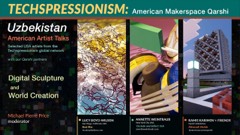
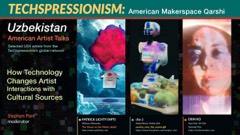
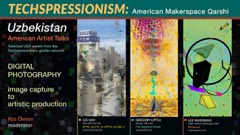
Cynthia Beth Rubin
Hi everyone. We're happy to be here today at the American Maker Space in Qarshi. We're coming to you virtually from different parts of the United States. And today we're going to talk about digital drawing and painting. This is a series of presentations and this is our first one. So we're part of a group called Techspressionism.
Cynthia Beth Rubin
And what Techspressionism is, it's a new term and you can read on the screen what it is. It's an artistic approach which uses technology and we're expressing emotional experience. We're working in a tradition of expressionism that has been around for a long time and we're also a global community. So we're happy to welcome you to that global community.
Cynthia Beth Rubin
We as a group have monthly salons co-working. We all get on we look at each other's work. We encourage each other to work. We have exhibitions and we have a large number of interviews online and you can find out more about us at any of these websites. The one that's Techspressionism.com is from an exhibit that we did. So let me know if any of this isn't working properly at any time because we're all friends here. So what you're seeing, what we've given to the space here, American maker space in Qarshi is a digital screen video that was part of an exhibit that we had in Urgench. So this is what brought us originally to Uzbekistan, this museum. And the director of the museum, Shirin Tashova, was absolutely so helpful getting us started, getting us interested in Uzbekistan, arranging the exhibit.
Cynthia Beth Rubin
And so here she is. You could see her picture. If you ever go to Urgench, she would be happy to show you the museum. So only a small number of artists could be in the original exhibit and so we made this digital video that you have been able to see. This is just a little bit about me. I'm not presenting today. I will be presenting this piece in a few weeks. But we thought it would be nice if I'm on screen. You might want to know that I work with plankton with microscopic life. So come back for art and science. We will meet them later. And these are the people who are presenting today.
Cynthia Beth Rubin
You just saw them on the screen, but it's kind of nice to see who they are again. So if they start talking and you're not seeing them, and we want to remind you that this is part of a series. So there are a number of upcoming sessions. We hope that every two weeks you will show up and find out more about what you can do with computers. So today we're talking about digital painting and drawing pixels as tools and substrate. Pixels as the actual material that you're using. And most our presentations are to get you motivated. They're about conceptual the ideas behind what people do, what makes them do what they do. But I will give you a very short overview of tools that you can use. So this is not instruction, but you can read on you see on YouTube. So you have on all of your computers or you should Microsoft Paint which is a painting program now included in the software.
Cynthia Beth Rubin
And the great thing about Microsoft Paint is that allows you to have layers. Many of the artists will talk about what it means to have different layers of image and put them together. And it allows you to make the little the image the picture on the left is what I scribbled last night quickly just to show that you can have a geometric form any geometric form curved or not and you can outline it and you can also draw on top of it. And the one on the right is from the Microsoft site where they're showing that you can different ways of working with a photograph and drawing and erasing which is a tool a lot of people use. Fresh Paint is a free piece of software that can be installed on your computers. I don't know if it's installed yet. And it does the same thing. It mimics it imitates it.
Cynthia Beth Rubin
Copies what regular paint does. And so you can blend colors together, you can make it look like watercolor, you can make it look like a pencil, but it only has one layer. However, what people learn is that you can make an image in one piece of software, save it, and then open it in another piece of software. So by putting these together, so photos which is on your computer was developed to change colors in photographs.
Cynthia Beth Rubin
But you actually can take the screenshot that I did yesterday when I was playing with painting and I made it all one color monochromatic hue with yellow on top of it. So, kind of boring, but there are reasons to do that in your creative process. Putting more on top or making much more interesting strokes. As you will see, one of our presenters does have some work that's in black and white. So, these are tools and again, you can save it and put it back into the other software.
Cynthia Beth Rubin
Gimp is free software that's very complicated, but not so complicated for those of you who are patient.and it's free and we have recommended that at some point this go onto your computers. This is a full range of possibilities. It is in one piece of software and I guess it took off. People have been asking me about printing out. I believe you have a laser printer and I wanted to say that laser printers do last for decades. You may read that they're not usually used for fine art, but if you use heavy paper, I have done projects that have been printed out on a laser printer and they do last. And then what many of us do is when we have something we really love or if a museum wants your work then you send it to someplace else to print called the service bureau or center where they will print it.
Cynthia Beth Rubin
And finally I just wanted to show you that most of the artists here use Photoshop. Photoshop is not free. It's pretty expensive, so it's something you would get if you decide to make being an artist your career. And everything that's in Photoshop, not everything, but a great deal of it is in Gimp which I showed you earlier, which is free, but you need to know what to look for. Gimp has an online community where people ask questions and other people will answer the questions for them. So, it's kind of fun that way.
Cynthia Beth Rubin
Okay. So, now we're going to get into the artist presentations, which is the really fun part.
Roz Dimon
I'm going to introduce you first to Roz Dimon, who has been doing digital art since the 1980s. She originally from Georgia, but she moved to New York in the 1980s. And her artwork focuses on American culture. She's in a number of museum collections. It's really impressive. The memorial museum for the 911. And she recently had her work acquired by the Abraham Lincoln Presidential Library, a museum, which she's going to talk about. And she has work in CAMUZ, and she shows at Carter Burden Gallery in New York. I was lucky enough to see her last show.
Roz Dimon
So Roz hopefully Oh, and just to give you all of the artists who are coming up again. Okay, so Roz, I think the is timing is on. Let's see if it works. Hello everyone. I'm so glad to be here. Reporting from New York and other places. Let me just talk first before I show you work. Things that we all should be thinking about when we start a digital work. How large or small is the piece?
Roz Dimon
What material are you going out to?how many are you going to make? One or one million? And how much will the price be? Is it a gift or what's the charge for it? So these are just things to think about. These are two pieces that recently showed in Uzbekistan, the new world view about football again and Lincoln number 11 with a QR code where you can see it animate on the right, which is part of a larger series. Just a quick close-up look at the football painting, digital painting, which is recent. You can see there multiple layers. I even take screenshots of the toolbar and put it in the piece as a sort of conscious reminder of I'm in this digital space.
Roz Dimon
And for me, it's always been important to show those marks. Here's Lincoln number 11, which is now part of the CAMUZ's permanent collection and part of a larger series. I'm showing you the series one edition on the wall at the Lincoln Presidential Library Museum where I recently spoke. It's about our 16th president. And it's kind of funny, but today is Lincoln's birthday. I don't know if you've heard of I'm sure you've heard of Abraham Lincoln, I imagine, and he's one of our most famous and great men in our history. Here are two pieces from another edition of the Lincoln, only 10 of each, and that's at my gallery in New York. Again, looking at those pieces, how many editions are you going to make and how many in each edition and how are you going to number them? Also, these pieces were influenced by this photo by Alexander Gardner from 1863 showing a man who kept our country together and united us through a civil war.
Roz Dimon
Always source people like knowing that photograph is very important. Make sure you have the copyright or if you don't purchase it. Again, this is the piece I'm talking about. Lincoln number 11, but there are 19 of them. A few of them are actually in not in digital. Here's a quick screenshot where I'm working on Lincoln number 11. I'm zooming in and out just like I would when I'm working on a canvas across the room. You can see all of the brushes that are the options, the multiple layers. Photoshop is just so powerful, but I mostly use the brush tool and the layering tool. This is a QR code that I also have in the collection and I actually frame these and have sold a few where people have these pieces and they let you into an experience of all the layers coming up one at a time. So that's one of the great things when you work with layers.
Roz Dimon
It's like going deep inside the math space of the digital, which allows us to be together right now, which I just find fascinating in every way, including spiritually, that we can be connected across the ocean right now. That was a fast rendition. Real quickly, the software I mainly use is Photoshop. Topaz lets you give more pixels and enlarge things. QR code generator. And I work with a young developer with software even though I have do coding myself.
Roz Dimon
I work on a MacBook Pro with two monitors, a Wacom tablet, a pen, and many other things. It's hard to remember everything, but you know, the most important thing is bring your heart and your mind to your project. That's the best software and hardware you will ever have, especially as a creator. Sign your work. I mean, anybody can learn tools, but it's what you bring to it. Create your file info if you're in a digital software and label your work.
Roz Dimon
You never know where your work's going to end up and people want to know it's you. Share your work. Let's be generous. This is an exciting, it's still digital is still in its evolving state. Of course, AI is around the corner. Here's a few shots of the recent show, with my fellow artist and Cynthia who kind of led the charge here. Thank you. It's been wonderful to get to know your country. The reception was just beyond my expectations and please be in touch.
Roz Dimon
Thank you so much and this is my Instagram handle. Please come share. Thanks a lot. Thanks Ros that was really great and we're going to have time for questions at the end. So think about some of your questions. I'm next going to introduce Ann Shapiro who began her career
Ann Shapiro
In higher education at teaching in universities or being a dean in a university and a professor and while she was studying for her PhD she started taking oil painting classes and then discovered computers. She actually told me it was through her nephew who was using computers and began working as a computer artist in the mid 1980s, as did Roz, as did I actually. And her primary medium is now digital art. So this is her website and I believe you have everybody's website also in the booklets and on the wall so you can look up more about the artists. So here we go.
Ann Shapiro
Good morning. My name is Ann Shapiro. I'm a landscape artist in New York City and I'm so happy to be with you today. My as you know my primary tool is Adobe Photoshop and I came to art as a landscape artist. I came to digital art as a landscape artist. One of my earlier works was Alaska. And why I take I work with countries, cities and states. And so it I didn't know Alaska.
Ann Shapiro
So I thought I would start with Alaska to learn about the country since I'm interested in changing landscapes. Came from my time as a child spending my summers on an island in the Atlantic Ocean. I fell in love with looking at the other islands and seeing how the landscape was constantly changing from daily to hourly, even from sunny days to cloudy days to rainy days.
Ann Shapiro
I love how the ocean looks and feels when swimming or watching. And I love studying the granite rocks and rocky coast and every day the changing landscape. You know your country for sure I think you will recognize it and hopefully when we move into the here we are with the final this is the final project that's on the digital screen as I said I was used to working with countries that were had water,water was a significant part on a river a lake or an ocean And you guess what? You may not know. I think you do. Obviously, you're surrounded by other countries.
Ann Shapiro
Kazakhstan, Kyrgyzstan, Turkestan. Well, you know better than I do. So, you're the first country I ever work did work about that was a what we call a landlock country or what? And what I wanted to do was I always worked with water. Now I had to do a desert. So I created my first gen AI generated piece and I created the desert on ChatGPT. I use in my work I use a variety of resources.
Ann Shapiro
Oil paintings. My old my oil paintings rarely if ever do I use someone else's and of course I would credit anything I would use oil paintings drawings photographs generally mine if they don't come if they're not my work I make sure it's I noted but I tend to use Wikipedia and as I said anything that's available in the public in the public range what I came to here we are went faster than I thought. One of the things I wanted you to note in the changing landscape is the last 20 years are red and I grew up in the blue zones and your normal is so different from my normal, my childhood normal. And, I think to do art and if you're interested in the landscape, you have to be aware of the changes that we're undergoing. Okay, this is my oil painting that I discarded and more recently I decided to take all my old oil well not all of them I take some oil older oil paintings again a landscape and add to it to create new work I now use color black which is bold uses of color and because I just love color and I was looking for a way to be able to deal with it more.
Ann Shapiro
And I don't know if you can see if it's generated, but you see the in the background the green you can see the ocean the painting through it. So again emphasizing we use layers. Layers are your friend in digital art because you can change anything at any time. Rework it, change it again. And in the foreground you see this is the final the black and on the top was originally the black on top of the original oil painting and so this is part of my series called concerning landscape. It gives me the opportunity to not have to look just at countries but to look at a variety of other avenues and this as I said it gives me more a less focused more general kind of approach to the landscape and I use the date. I just want to finish with digital you need to date it. You need to be able to record what you're doing and it there's sometimes there's a lot of art so I use the date the date becomes the way I can identify the work okay here we are I'm originally from New England if anybody knows that area and I'm awfully glad to have been able to speak with you today I encourage you to artists use the term play you want to get in there.
Ann Shapiro
Don't be afraid to make mistakes. It's from the mistakes you make that you grow. So, keep that going. I hope that you will have questions afterwards. I hope that this is will aid in your understanding of some of what's involved in becoming an artist. Thank you very much. That was Thank you, Ann. That was really wonderful and yes and everybody should have website you can go and look at more work and find an email address too. So go ahead. Well, we're going to jump to Stephen Paré and come back and have time for discussion.
Stephen Paré
So Stephen Paré is originally from Ithaca, New York. He began his career in music and acting and he still is involved in music. In fact, he did the music for the digital screen. Oh, that was the spelling mistake ever was pointing out now. I see it. Composted instead of composed. I was looking and I couldn't find it. Okay. So, using an automatic spell checker, I type very, very fast and sometimes it guesses the word and then I don't see it made a mistake. So, down at the bottom. Okay.
Stephen Paré
He has been exhibiting visual art internationally for the last few years, but he's managed to be in many places in the world, which is very exciting. So he will tell you this himself, but Stephen really uses Instagram a lot. So it's important for him that you make note of his Instagram account. And he now lives in Houston, Texas, which for some of us is very far away. And in fact, I don't think I have ever been to Houston and I don't know very many people. Stephen, I think you're the only person I know from Houston. So that's just an interesting aside. Okay, here we go.
Stephen Paré
Yes, I may be in Houston, but I'm just a click away, aren't I? So thank you Cynthia and thanks also to American Corners for hosting this event. I'm showing five pictures that were seen in Uzbekistan recently and this is an occasion to thank the people of Uzbekistan. Here's one of them in closeup and gives you an idea of the kind of work that I do. I make my art on tablets on iPad and I use particularly a technique called glitching. Glitching is a disruption of an image.
Stephen Paré
So I start with photographs. I use photographs that I've taken and photographs that I've screen grabbed from the internet. So, I'm going to take a picture actually that I've grabbed and show you the kind of work that I might do with it. So, this glitching, this remixing, like we say in the in the music world, mashing up, you might even have heard that expression. So, what I'm looking for in remixing, in glitching, is a kind of musical result, rhythm, repetition, structure.
Stephen Paré
And I think that something very interesting starts to happen when you combine the photographic the kind of storytelling you get from photographs when you combine it with this these musical qualities. I think something actually sort of poetic starts to happen. So, I haven't developed any of these. These pictures are sort of on the way somewhere perhaps.
Stephen Paré
I love patterned forms. I'm very fond of the patterns you find in oriental rugs, for instance. The kinds of traditional patterns that you can find in textiles and old architecture. And there's a for me extremely interesting meeting between that digital patterning and the photographic and the storytelling. If you do glitching and that kind of thing, there is a poetry in it, but it requires you to be patient. So, I am showing you some things some images that I preserved, but I'm estimating probably one in 20 I save and maybe one in 20 of those are things that I would actually show. Most of my glitching has just put in the trash. I've had to learn to be happy with discarding with throwing things away.
Stephen Paré
But all sorts of interesting things can happen. Now I'm I want to show you more finished work. Now this is getting closer to being finished. So I added that light. There are all sorts of things that make sense. Interesting things happen. And when you're repeating the glitching, the creation of repeating patterns, all sorts of interesting things happen.
Stephen Paré
Now, you may remember the original picture. There was a woman on the left. And this glitch was especially interesting for me because that person on the left is now sort of two people and they seem a little less female, a little more male. It's not that the I'm looking for something ambiguous, but this is a final version. And there's a quality of a human being there, but there's a kind of a richness I think that has happened in the progression. So I'm rather happy with this final project. There's my website and please do follow me on Instagram. So I'm delighted to be connected with you. I can sort of see some faces out there and hello. But come contact me on Instagram. Show me your work. Happy to share myself. That's it. Thanks a lot.
Announcements
Great. So we want to thank you. We're going to have discussion now, so don't go away. But we want to thank the makerspace for hosting us and also CAMUZ for getting this whole project started of bringing us to Uzbekistan. And I do want to say our exhibit is also at Art Station in Summer. We thought it was be closed by now but we have heard that it's there. These are the upcoming sessions and many overlaps. So, we broke this up so that there would only be a few artists so that we would have time for questions. But in each one of these categories, you will find artists who use the painting tools or when people are using AI, you will find that there are people who are painting who are also using AI as Ann just mentioned that she got the desert from using ChatGPT. So these are if you put them all together, you'll find out some of the things that can be done.
Discussion
So that we can see everybody. Great to see you and I can ask my fellow panelists here to unmute and I have a list of questions but I wondered if any of you had a question right away before we get going. Okay. Anyone in the group? I think you have a laptop there so you can answer questions. So, how many of you in Uzbekistan do now paint or draw or just what we call doodle? Play around on paper and paint and draw. Are you painting now?
Discussion
Okay, you're getting feedback. So, you need to mute one of the Okay, great. Sorry. Yes. Perfect. Okay. Raj, you're muted, by the way. Can you at least talk? So do you now paint or draw on paper? Yeah, we were in school painting model stuff and we got opportunity to draw anything on paper or computers here.
Discussion
Wonderful. So you are already painting on the computer here. Yeah. So you've already discovered Microsoft Paint. Yeah. A lot of people know about Microsoft products in Uzbekistan for example Microsoft slideshow, Microsoft products like Microsoft visuals and so yeah I personally know about that products and I don't know it is my opinion Great. That's good to know that people are there, that you're using it. And have you do people have you thought about moving an image from one piece of software to another piece of software and then back again? Yeah, it is kind of artistic. You're saying stuff that I think that's very complicated driving something like this but also required
Discussion
Like artistic creativity. Yes. Right. Yeah. It is not easy I guess. Totally. So even though now we use Photoshop and I can let other people talk, many of us began be when we had to do that when one piece of software would not do everything that we wanted. And so one of the things is it's important to name your piece and to make folders and be able to find it so you don't spend all of your time going, "Where did I put that?"
Discussion
And you're nodding your head, right? Yes. Really important. I got lucky. We referred to my nephew. He showed me how to set up. So now I have a folder. It's generally called art. And then since I do a variety of different things, I make a category. It doesn't matter what you call it if it's familiar to you. That's what you call it. You can I'm always changing it. New things come in. So you adapt it. But make sure you name everything. I wished I did name everything, but it's my good intention to name everything. When you name it, however you do it, you'll be able to find it again. Yes. Name, name, name, file it. 100%. Yeah. Right. I'm also curious to know if any of you if you use your phones for taking pictures or for drawing on your phones.
Discussion
Does anybody use your phone for making art? Are we talking to the participants or to the to Kari? Good question. Becca, I'm not sure people know. Okay, first let's good. I'm very good. First let's see if anyone in the maker space has an answer to that and then I would love to hear from our participants how they use their phones. I'm supposed to when we go out we'll take them in the car in his bag.
Discussion
Do any of you use your phones? Yeah. On my free time I always try to take picture of the nature especially when it's rains and snows and I think that's a kind of piece of art. Great. And then do you bring that into the computer or have you tried that yet? Or but no still I haven't delivered it to any computer but I am planning to post it on social media.
Discussion
Okay. But now you see you can bring it into the computer and do even more with it. But I have seen so many times before people are bringing it to the computer and creating the art that you have like you have showed before. Right. So participants speakers I just wanted to echo what Ann Shapiro is that there's so many options in digital. Some people really can't even work in it because there's so many options.
Discussion
So what Ann was saying is so important just like the layering. It's good to even name your layers to figure out which one you want to put where. But to your point about bringing in photos, you can do so many things with it and it can turn into 20 paintings or one painting and as you go along and become more excellent in what you do. You want to raise that bar and not show everything to the point that I think it was Steven who said how much he throws away. I mean, it's important to raise that bar so that form and color and your creativity and the digital tools you're using, you know, that you really go for the best piece.
Discussion
That's what I would encourage you to do. But it can be confusing. Digital art is not for everyone, but it is a sign of our times and it is a signature to the world we live in. Yes, Stephen, I'll say yeah. I knew you were going to ask me next. I have only ever been a digital artist. So I have never used paint or pencils except in the most you know rudimentary childlike way. And most of the work that I do I do on tablets on an iPad and I use a phone often as a camera but mostly in order to produce a photograph that I can then take into my iPad. I'll just say one more thing about two more things about that. First is I love being able to make art anywhere. So, my ideal place for making art is on a train and with a nice rhythm under my seat and being able to work on the screen. The second thing I wanted to say about that is the iPad allows me to use my finger as a brush.
Discussion
So there's software that you can you know that converts your touch on the screen into paint strokes and such a fascinating way to be making art for me. And so that is one of those combinations, photographic storytelling and also the feeling of the touch on the screen combined with the those digital things those things that I use that are structure that are architecture
Discussion
That are rhythm and the glitching that I was talking about before. I think that's about enough. I believe that the laptops that you have, you can use your finger on the screens. So, you can do it. I want to just tag on to that, Stephen. That I work in all media still, but mainly digital, but recently I'm going back to, you know, using Conti Crayon and charcoal on paper and my work does look alike. You can see my drawing skill and my touch. But the thing about digital that was one of the reasons I got into it in the first place when my paintings filled with squares in New York City in the 80s it was all an accident but I was listening to a digital world but the thing about digital is it shows I mean I think it's important we nothing it this is from my point of view but I wanted to capture that t that electronic look like my digital marks on my Lincoln they're still my marks but they look different than the ones that I draw and they have jagged electronic edges and they show the medium.
Discussion
So just maybe be aware of that of not trying to perfect nature and make something, you know, the way you see it. There's no way to really replicate. Everything's abstract. But to be take the interruptions and be creative and be open to things because you're expressing a different kind of creativity your personality coming into the photo or whatever it is that you bring in. I hope that made sense. I talk in circles. Before we turn to Ann who has is bursting with ideas and things to say, I don't know if you're familiar with the word medium that artists use. So when we say medium, we mean material in the art world, but it's kind of if we use art world talk that you're not familiar with, please, you know, ask us. Mediums are something even native English speakers don't always understand.
Discussion
When artists say the medium, they mean the material. Okay. And you were no, I wanted to tag on to what Roz said, make mistakes. If you don't make mistakes, you're not learning and you're not growing. Make as many Excellent. And we don't and I, let me just tag to that, when we say learning and growing, we don't mean beginning artists. We mean those of us who have been artists for 40, 50, many decades. We still think of ourselves as learning, right? Right. And that's a great comment. But I just want to say that, you know, the wonderful thing about art is it's a universal language. You know, you may speak, we speak English, even though you're doing a much better your English than we are in the language of Uzbekistan but it's important. But the great thing about when you make an art world and share it with the world, I mean an art piece is that it speaks
Discussion
In a language that everyone can be a part of. And that's one of the most exciting things I think going on here that recognizes that especially as we're able to share things across the world. So it you have a lot of power. You can say a lot with this universal language. So do any of you in the makerspace have a question for any of us right now? I got a question. Where are you right now? Where you from? Oh, which state in US? Yeah, we did have it on the Ah, okay. Okay, be we'll just go Roz and Stephen. And you're in not just which state, but may say a little something about the town that you live in. Okay. Should I go? Okay, I'll jump in here. I live in Shelter Island, a little island about three and a half hours from New York City, but I consider myself a New Yorker. I lived in New York for 30 years.
Discussion
I love it. It's the most tolerant place in the world. And, it's where my digital, my interest in digital became. I mean, as I said, I was an oil painter. I drove from Atlanta, Georgia up to New York in my Volkswagen. And I was going to be famous like everybody else. And I'm making fun of all of us, but it's important and New York has so much creativity and so many artists. And my paintings filled up with squares. And I loved how there were so many different people from different countries just waiting on one subway stop. And how it's just the most tolerant, loving, open city. And so I would call myself kind of a New Yorker first. It's where I came into my being. And we all know things that happen in our lives where we all of a sudden explode into becoming who we're going to be in an important way.
Discussion
But you were born in Georgia. I mean one thing I was interesting you were all born. Yeah. I was born in Denver, Colorado. Actually was raised in Georgia and I'm now talking to you from Charleston where I'm visiting how we can all do this right. Oh it is okay. Great. Charleston is it North Carolina? South. I can't South Carolina. South Carolina. Okay. Great. Thanks. And well, that's interesting for me because where I'm from has everything to do with my art.
Discussion
I'm from New England, which is in the state of New Hampshire, which is a little bit north of Boston. You've heard of Boston? I have a feeling. Heard of Boston? Anybody? Massachusetts. No. Yeah. Yeah. Okay. No. Okay. And so go an hour, drive your car an hour north and you hit my hometown of Manchester, New Hampshire. But I spent all my summers as a little girl in Maine, which is go further north, another five, six hours on an island. And that's where all my art comes from.
Discussion
Everything I do I is based on my childhood. My childhood experience, my childhood life, my childhood loved. However, I've been living in New York longer than I lived in New England in New Hampshire. And I love New York. I wouldn't live anywhere else. Given my choice, this is the place I want to be. And I've lived here longer than I lived in New Hampshire.
Discussion
But nonetheless, my roots and I don't know that's for everyone. But I think you'll find your childhood experiences is even as you grow older become are really such a big part of you. I worked in academic world. That's not my painting. That's not my drawing. It's I don't draw the academic world. I draw my childhood and how I feel about it and what's happening. Yeah.
Discussion
Great. Thank you. Thanks, Stephen. Well, I won't say as much as Roz and Anne did. I live in Texas and that probably gives you a certain idea about things that maybe is not so accurate. So, I don't wear cowboy hats and, you know, rustle steers and things like that. Houston is Yeah. So Houston is actually a very large city. It's the fourth largest city in the United States. So it has all the things that a large American city has to offer. But I would say as an artist I live online and I'm delighted by being able to do that and to associate with such people as Cynthia and an Roz to show my work and also to connect with you. Great. Thanks. So I'll answer very briefly for myself too and by the way that is my image of Texas cowboy hats. So I did live in but Montana for a year which is a much smaller city in the Rocky Mountains where people still are cowboys.
Discussion
So I'm like have that image. I'm originally from Rochester, New York which is the third largest city in New York State and it is not a suburb of New York City. It is about a well, when I was a kid, it was about an eight hour drive. You know, Americans talk in time, not in miles or kilometers. We don't even know miles and kilometers.
Discussion
And now it's probably still about a 7-hour drive. It's across the lake. It's on Lake Ontario, which is the furthest east of the Great Lakes, dividing the United States and Canada. So, it's
Discussion
Roughly opposite Toronto. And I've spent much of my life on the border. I've lived all over. I went to school in Ohio. I lived in Montana. I lived in New Hampshire. I lived many years in Vermont, but now I live in Connecticut, which is in between New York and Boston, but much closer to New York. And I live here because I can get on a cheap train that runs two trains an hour. And I will be in New York in 2 hours, which sounds like a long time, but now that you have your laptop and your phone, you just get on the train and you work and then next thing you know, you're in Grand Central Station. And sometimes I feel like where I really live is in Grand Central Station.
Discussion
Oh. So, great. Any other question? Yeah, I want to say I'm from New England. We talk in miles. The reason she talks in time in hours is because there's more traffic. Honey, more cars. Yeah. I learned this in one of my jobs where I had to drive. Yeah. But we all talk in pixels, right? We can all agree on that.
Discussion
Yes, 100%. We talk in pixels. It's communication. It's interesting how you can live right next door and not even know your neighbor. So, it's endless. Communication is the thing to work on. Do you have any other questions for the artists? I got a question personally. Do you know about Leonard Cohen? It. He is a singer from New York and famous. I think you should know about this artist. What's his name? Leonard Cohen. It is classic European style artist and he's very famous in New York. He got famous music called Thousand Kisses Deep.
Discussion
Oh, great name, great title. We'll look at it. We'll look into it. Yeah. Where is he from? He's from originally Europe but he's most of work of arts about America United States of America and he's very famous actually Leonard Cohen yes sorry oh we love him he's actually a mantra Hallelujah favorite. He's actually a Montrealer. He's from Montreal. Yeah. And when I lived in
Discussion
Vermont, my big city was on the other side of the border. Montreal was my closest city. I would go about once a week. And everybody in Montreal, oh yeah, I know his uncle. I know, you know, he's so it was important to the community. And then he lived in New York and for our generation he was really the greatest Leonard Cohen and then he actually moved to California at the end of his life. And yeah he spent some time in Greece but and Canada is very proud of him. So, as well, I wanted to share something since you brought up Leonard Cohen, and I think we can all relate and it kind of gets back to Steven's point about and all of us about making mistakes. Ann I think really said, "Yeah, don't be afraid." But Leonard Cohen said, "Ring the bells that still can ring.
Discussion
There's a crack in everything. That's how the light gets in." Yeah. I love that. Thousand kisses to that. Yes. Very good. Yeah, he inspires. And by the way, listening to music when you work can really keep you going. So, I'm glad that came up. Inspiration. It's inspiration. Yeah. Okay. I love how your country says thank you. When we were in your country so many times they were everyone was so generous and then they would put their hands over their heart and we just my husband and I both James Dawson he's such a part of my work we just love that response and thank you so much it's a privilege to have my work in all of our work in your country and have this dialogue thank you yes I want to add to that I grateful for the welcome that I got in Uzbekistan and everywhere I went, people were generous.
Discussion
People went out of their way to help me. I'm grateful and so happy that I got to visit your country. I didn't visit, but I'm happy to be sharing this experience with you. And I have to say when I start a project I'm not listening to music. When it's working on it I'm listening. But at the beginning silence. Yeah.
Discussion
We all work differently. That's what makes the world a happier place when it can be. Yeah. So any more questions? I'm curious. We're running up on the end of our hour and we were trying to stick to an hour,
Discussion
But one of the things I wanted to mention was feeling the wall of the computer screen. Like it feels like something you can't get into and then at some point you break it and it feels as natural as anything else that you do. Is as natural as drawing on paper. And I wonder if you're in the middle of breaking that wall or if you've all broken it, how you feel about it?
Discussion
Does it feel comfortable for you yet on the computer? Absolutely. I love anything about America. I love America. I love American people. I love every single American thing. I'm totally I love New York City, Texas, California. It is culture. It is future. I love anything about America. I personally love all of you.
Discussion
Thank you. You know, it's not actually the same culture. It's good that I'm very glad that you asked the question about states because we have some differences as you move around. We'll keep it at that. We'll keep it at that. Yeah. Culture very different. Yeah. The freedom to have different opinions. We still have that. That's good. But it's nice to hear that. Yes. Anybody else have any other questions for us?
Discussion
Okay., so yeah, before I just wanted to end on kind of saying how wonderful it is to see your space, how great it is that you have access now to these computers and also to each other. Is one of the things that if you can work alongside other people, this is why Ann and Stephen Paré and I are part of this virtual co-working where we get together online because many of us work in private studios in our homes or elsewhere and this whole group Techspressionism you are welcome to join We have once a month we have open presentations and depending I guess the next one will be after the time change so it will be 10:00 at night for you but you can join from your home and watch on your iPhone if you don't have a computer at home and or you have Androids, whatever phone you have. And so if you
Discussion
Go to that website, Techspressionism.com, you will see a place to register. And we have guides for you can put captions on so that you can follow people when they're talking and or you can put captions on that will come up in Russian. Unfortunately, Uzbeck is not a language translated by Zoom, but you're welcome to come. So, go to the website and we hope you can also sign up for the salons at Techspressionism.com. You can sign up and be part of our monthly we meet once a month.,and you can go sign up and be invited and maybe you'll even start a Uzbekistan chapter. Wouldn't that be exciting? Yeah.
Discussion
Of Techspressionism. Yeah. Started by Colin Goldberg. If any of you stay up late enough and want to come, we go very late with our co-working sessions. So, the salons might be Yeah, they're usually just an hour and you can come in and but it's good to stay so that you listen to people. So you're welcome to sign up for that and it's the first Thursday of every month. So we tried to have them not the same days as this series but they might be. And please tell your colleagues to come next month. You know, we are aware that next month's for those of you who'll be fasting that we'll be in the middle of that you'll break your fast in the middle and we are planning to give you a little break for that. So, that's one of the things as Americans we honor traditions.
Discussion
So, if there aren't any more questions, we tried to finish this within an hour because I think your center is closing now. Yes. Is that right? Thank you for the social. It was very full of information and it was also useful for us. And this from this session I have started to get interested in the art especially in the digital art. Great. That's wonderful. Yeah. Great. So thanks. We're so happy to know all of you. So please go to our websites, get in touch with us.
Discussion
We will make sure you have people's email addresses if you want to ask any more questions or just follow us on Instagram. Thank you. It was such a great session. So lovely. Thank you so much for like sharing what Techspressionism is. Greatly appreciate it. Thank you so much for your time.
Discussion
Great. Well, it's wonderful to see everybody and to my little group. Maybe we'll get together in a different Zoom room in a little while. I can send you a link if you want to. We will try again. Yes. Yeah. Try again. So, we hope to see you in two weeks. We have Cha is on here in the audience. He is the person who will be moderating in two weeks. So we hope to see you and Okay, great. Thank you. Thanks. Thank you. Okay, bye.